
If only..
If only everyone shared Edison’s sentiments then there would be no dearth of ‘light bulb’ moments and our lives would be brighter. But alas, fun not only seems to be missing at workplaces, it’ll also probably start being recognized by Oxford dictionary as an acceptable antonym for work.
Making work fun should not be the responsibility of only HR professionals but should cut across all functions and all persons responsible for a team.
Recognizing that “Traditional incentive structures to motivate customers and employees often fall short. The carrot and the stick don’t cut it anymore; and money, status, and the threat of punishment only work up to a point. In a world of near-infinite choices, the old techniques are rapidly becoming less effective” authors Kevin Werbach and Dan Hunter believe gamification is the solution to ensure that employees are not “disengaged, demotivated, disempowered and disconnected.”
In their book ‘For The Win: How Game Thinking Can Revolutionize Your Business’ they attempt to provide you with a sophisticated understanding of the concepts around gamification along with providing frameworks and step-by-step instructions to implement your ideas along with examples of how organizations of all types are putting gamification into practice.
Here’s answers to 7 questions that might be slowly poisoning you if you want to know how gamification rhymes with motivation.
-
What is Gamification?
Gamification is the use of game elements and game-design techniques in non-game contexts.
Example: Consumer electronics giant Samsung has gamified its website with a program called Samsung Nation. Players can earn badges and level up by reviewing products, watching videos, and providing responses for product Q&As. Samsung built a point system that assigns values to all these actions. Sharing an action on Twitter is worth 100 points, while registering a Samsung product you just bought is worth 500. The 5-to-1 ratio is arbitrary, but it represents a rough estimate of the relative benefits to the network of the two activities.
-
How does gamification in business help?
There are three particularly compelling reasons why every business should at least consider gamification:
- Engagement
- The most basic answer is that gamification is about engagement. The same human needs that drive engagement with games are present in both the workplace and the marketplace. Think of gamification as a means to design systems that motivate people to do things.
- The reason for this is simple. It turns out that our brains are wired to crave puzzle solving, feedback and reinforcement, and the many other experiences that games provide. Study after study has shown that games activate the brain’s dopamine system, which is associated with pleasure.
- Experimentation
- Mastering a game is all about experimentation. You expect to experience some failure, but because you can always start over, failure doesn’t feel so daunting.
- If the game is effective—not too difficult, never too easy—players are continually motivated to strive for improvement. And they are encouraged to try new and different approaches, even crazy ones, to find better solutions.
- Results
- It works. Which is why established giants such as Nike, American Express, Microsoft, Samsung, to name a few, are doing it.Top of Form
-
Where does gamification fit in your business?
To figure out where gamification might fit your needs, consider the following four core questions:
- Motivation: Where would you derive value from encouraging behavior?
- There are three main kinds of activities for which motivation is particularly important:
- Creative work,
- Mundane tasks, and
- Behavior change.
- Meaningful Choices: Are your target activities sufficiently interesting?
- Structure: Can the desired behaviors be modeled through a set of algorithms?
- Potential Conflicts: Can the game avoid conflicts with existing motivational structures?
-
Why games work? The rules of motivation
Self-Determination Theory (SDT) suggests that human beings are inherently proactive, with a strong internal desire for growth, but that the external environment must support this; otherwise, these internal motivators will be thwarted.
- SDT focuses on what human beings need to allow their innate growth and well-being tendencies to flourish.
- SDT suggests that these needs fall into 3 categories
- Competence – “Competence,” or mastery, means being effective in dealing with the external environment: pulling off a difficult deal, learning how to dance the tango, filing a tax return.
- Relatedness – “Relatedness” involves social connection and the universal desire to interact with and be involved with family, friends, and others. It can also manifest itself as a desire for higher purpose, or “making a difference.”
- Autonomy – is the innate need to feel in command of one’s life and to be doing that which is meaningful and in harmony with one’s values.
There are 3 rules of motivation:
- Always focus on building authentic engagement; there are no shortcuts – Gamification is not just reward design. Many gamified sites and gamification platforms seem to assume that a virtual reward is inherently compelling. It’s not. It might be a pale substitute for what people really want and might actually kill intrinsic motivation. Internal gamification can work for core job requirements, but there must be some novel motivation. That could be the status of winning a coveted employee award or the opportunity to learn new skills.
- Don’t mindlessly attach extrinsic motivators to activities that can be motivated using intrinsic regulators. Extrinsic rewards can encourage positive behavior and outcomes when one is dealing with dull, repetitive, and/or tedious activities – Fun Extrinsic rewards can be profoundly demotivating. Any gamification design has to take this into account. Sometimes giving people a bigger benefit to perform some activity will actually make them do it less, and worse. For tasks that are interesting, intrinsic motivation dissipates when extrinsic rewards are tangible, expected, and contingent. It turns out that if you give kids tangible rewards like gold stars for doing well at reading—or, worse, if you give them money—they will improve up to a certain point and then stop. The tangible, expected, contingent reward initially motivates the kids, but its effectiveness plateaus dramatically.
- Feedback in a gamified system can be the linchpin of effective motivation – In building successful gamified systems, immediate and frequent feedback is necessary but not sufficient. Here are three important lessons about feedback:
- Unexpected, informational feedback increases autonomy and self-reported intrinsic motivation.
- It means that people enjoy being surprised by achievements and rewards that they didn’t anticipate.
- Example, when you know that if you tweet 100 times about a product then you will get a “You Tweeted 100 Times About Our Product” badge—getting an unexpected badge or trophy stimulates positive feelings in the user.
- Users like to get reinforcement about how they are doing.
- Informational feedback about progress toward a goal—“You’ve completed three out of the five steps necessary to unlock the AWESOME JOB badge,” or providing some continuous graph of performance against specific metrics—will typically engage a player and may motivate him or her to complete the other steps necessary to complete the task
- Video games are veritable feedback fests, filled with scoreboards, flashing colors, musical fanfare, and more, whenever something important happens.
- Users will regulate their own behavior based on which metrics are provided to them.
- If you provide feedback loops about customer satisfaction but not about sales figures, employees will begin to care more about customer satisfaction than monthly sales, and vice versa.
-
What are the characteristics of an effective game?
- Games are voluntary – No one can force you to have fun. Top of Form
- Games require those who play to make choices, and those choices have consequences that produce feedback – The choices may involve picking a weapon in a first-person shooter videogame or playing a particular word in Scrabble.
- A game can simply be defined a “a series of meaningful choices.”
- Contingent choices highlight the connection between games and autonomy.
- Players feel a sense of control in games that is deeply empowering.
- Even more essential is the fact that games seem somehow different from mundane reality.
-
What are the elements of a game?
- Points: Points effectively keep score
- Badges are a chunkier version of points – A badge is a visual representation of some achievement within the gamified process. (The terms “badges” and “achievements” are often used synonymously in gamification.)
- Badges can provide a goal for users to strive toward, which has been shown to have positive effects on motivation.
- Badges provide guidance as to what is possible within the system and generate a kind of shorthand of what the system is supposed to do. This is an important feature for “onboarding,” or getting the user engaged with the system.
- Badges are a signal of what a user cares about and what he or she has performed – They are a kind of visual marker of a user’s reputation, and users will often acquire badges to try to show others what they are capable of.
- Badges operate as virtual status symbols and affirmations of the personal journey of the user through the gamification system.
- Badges function as tribal markers
- Leaderboards
- A leaderboard gives context to progression in a way the points or badges can’t. If performance in the game matters, the leaderboard makes that performance public for all to see. In the right situation, leaderboards can be powerful motivators. Knowing that it’s just a few more points to move up a slot or even to emerge on top can be a strong push for users.
- On the other hand, leaderboards can be powerfully demotivating. If you see exactly how far you are behind the top players, it can cause you to check out and stop trying
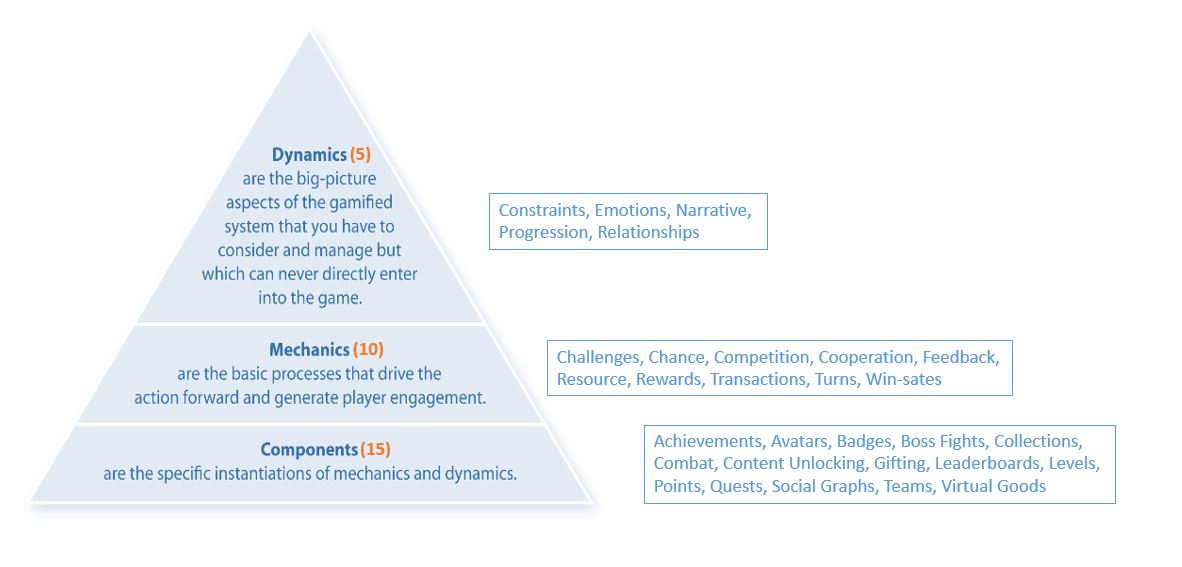
Furthermore, there are three categories of game elements that are relevant to gamification that may be of help to understand and apply:

Game Elements relevant for gamification
-
How to gamify your business?
Gamification is best implemented in six steps –
- Devise activity cycles – The most useful way to model the action in a gamified system is through activity cycles, a concept that has gained traction in describing social media and social networking services. User actions provoke some other activity, which in turn provokes other user actions, and so forth. Think of a user tagging a friend in a photo she uploads to Facebook, the upload triggering a notification message to the second user, the second user posting a comment on the photo, a new notification going back to the first user, and so on. There are two kinds of cycles to develop:
- Describe your players –.
- Ask what might motivate your players
- Hint: Players have been categorized as 4 types
- Achievers love the rush of leveling up or earning a badge;
- explorers want to find new content;
- socializers want to engage with friends;
- and killers want to impose their will on others, typically by vanquishing them
- It’s easy to design for four representative avatars—Lucy, Bob, Layla, and Faraz—but it’s hard to design for audience segments like “white, well-educated female players between 25 and 40,” “blue-collar male players who don’t like games,” and so on
- Define business objectives – define specific performance goals for your gamified system, such as increasing customer retention, building brand loyalty, or improving employee productivity
- Delineate target behaviors – Focus on what you want your players to do and how you’ll measure them. Behaviors and metrics are best considered together. Target behaviors should be concrete and specific, for example:
- Sign up for an account on your website.
- Post a comment on a discussion board.
- Exercise for at least 30 minutes.
- Engagement loops describe, at a micro level, what your players do, why they do it, and what the system does in response.
- Progression stairs give a macro perspective on the player’s journey. They reflect the fact that the game experience changes as players move through it. That usually means an escalating level of challenges
5. Don’t forget the fun! – Ask yourself the following question: Would players participate in your system voluntarily? If there weren’t any extrinsic rewards offered, would they still be likely to play? If the answer is no, then you should think about what might make your system more fun. Nicole Lazzaro, a game designer and consultant who is an expert on the emotional aspects of games, found four distinct kinds of fun in studying a group of game players.
- “Hard fun” – is a challenge or puzzle, which is fun because of the pleasure of overcoming it.
- “Easy fun” – is casual enjoyment, a way of blowing off steam without overly taxing yourself.
- Experimental fun – It’s the enjoyment of trying out new personas and new experiences.
- Social fun – or “the people factor” is essentially the kinds of fun that depend on interaction with others, even if competitive.
6. Deploy the appropriate tools
- In broad brush, though, you’re going to need a way to track interactions with game elements and integrate those results with your existing business systems.
Let the games begin!







 Arbit Musings