Category Archives: Geek Peek

So you think you can write!

“The two kinds of people are those who think they can write, and those who think they can’t. (And too often both are wrong!) – Ann Handley

Even if we aren’t professional writers, most of our professions require us to write, every day. We write to communicate, to persuade, and with the advent of the internet, simply share. Yet we pay little or no attention to improving our writing skills. Most likely because we think we can write well enough for the person at the other end to understand what we are saying and we can get by our jobs (mostly the ones which are not linked to professional writing) without any real need to improve.

Maybe that’s true. Maybe that’s not.

For reasons beyond my comprehension, I decided to blog from this year (2015). So I figured, if by the off chance, people stumble upon my ramblings, then I owe it to the unfortunate reader to allay the horrors that may come his/her way. With that in mind I recently devoured a highly recommended book by Amazon – Everybody Writes: Your Go-To Guide To Creating Ridiculously Good Content by Ann Handley.

I recommend it too (not highly) if you are looking to improve your writing, for professional purposes or otherwise. She covers 75 very very practical tips that cover how to write better, grammar and usage, telling a story, publishing, social media writing tips and content tools that you can use.

But then I know that you are too busy, which in my parlance is lazy, to read 282 pages of what you think you already are a master at. So in my attempt to earn ‘good karma’ brownie points, I’m sharing my top take away and learnings, (which I shall also try to apply bit by bit), for the good souls who want to improve but are too lazy, er busy to learn. After all, she argues that “writing is a habit, not an art.”

  1. Quality content means content that is packed with clear utility and is brimming with inspiration, and it has relentless empathy for the audience. “Start with empathy. Continue with utility. Improve with analysis. Optimize with love.”
  2. Follow a writing GPS – Good writing takes planning and preparation; it doesn’t just emerge, fully formed, out of the head of Zeus. Or your own head, for that matter.
  3. Organize – Good writing is like math: it has logic and structure. (There’s no single way to organize a piece of writing though)
  4. Swap Places with Your Reader – Good writing serves the reader, not the writer. It isn’t self-indulgent. Good writing anticipates the questions that readers might have as they’re reading a piece, and it answers them.
  5. Develop pathological empathy – Use a customer/audience-centric POV. Replace ‘I’ or ‘we’ with ‘you’ to shift the focus to the audience/customer’s point of view.
  6. Put some extra thought to writing a good lede (Opening). Some ideas are –
    1. Put your reader or someone just like your reader into the story.
    2. Describe a problem your reader can relate to.
    3. Set a stage.
    4. Ask a question.
    5. Quote a crazy or controversial bit of data.
    6. Tell a story or relay a personal anecdote.
    7. Other options – Start with a quote. Use an analogy. Make a bold statement.
  7. Place the most important words (and ideas) at the beginning of each sentence. Hence, phrases to avoid at the start of a sentences – (You can tack them onto the end, or insert them somewhere in the middle—if you must use them at all.)
    1. According to…
    2. There is a…
    3. It is [important, critical, advised, suggested, and so on]…
    4. In my opinion…
    5. The purpose of this [email, post, article] is…
    6. In 2014 [or any year]…
    7. I think [believe] that
  8. Ditch Weakling Verbs – Instead of: In his anger, he accidentally cut his finger. Try: In his anger, he accidentally slashed his finger.
  9. Limit moralizing or preaching. So avoid phrases or words like –
    1. Don’t forget…
    2. Never…
    3. Avoid…
    4. Don’t…
    5. Remember to…
    6. Always remember to…
  10. Break some grammar rules (these 5)
    1. Never start a sentence with and, but, or because.
    2. Avoid sentence fragments. It’s perfectly fine to sparingly add sentence fragments for emphasis. At least, sometimes. (Like that.) (And that too.) (And this.)
    3. Never split infinitives.
    4. Don’t end a sentence with a preposition.
      1. One big unless: “You shouldn’t end a sentence with a preposition when the sentence would mean the same thing if you left off the preposition,” Grammar Girl notes. “That means ‘Where are you at?’ is wrong because ‘Where are you?’ means the same thing.
    5. Never write a paragraph that’s a mere one sentence long.

If you’re still curious for more… social media writing advice, tips like ideal length of FB posts, Tweets, Blog lengths, writing headlines or landing pages or even a repository of content tools to simplify your writing process, you’ll have to take that little bit of extra effort to go through the 282 pages of Everybody Writes: Your Go-To Guide To Creating Ridiculously Good Content by Ann Handley.


Why is life so difficult?

There are times in our life,
When we think it’s not worth the strife.
That we’d rather quit this crap,
Get the hell out of this miserable trap.

Like many if you too think life is hard,
That you’ve been dealt the wrong card,
Maybe it’s time to pause,
Time to reflect upon the cause.

If your mirror does not lie,
And to see the truth you are not shy,
In the reflection you will see,
Life is only as difficult as YOU make it to be.

Relinquish your obsessive need to control all of your existence, 
And the Universe will yield to your every wish, even if it’s nonsense.

Trincomalee

Had a whale (literally) of an Easter weekend @ Trincomalee.                                                        Thought I’d share it in the form of a poetree.

Thank you Trincomalee for reminding me,
Of the world that we forget to see.
Of the beauty that cannot be painted,
And the miracles that we take for granted.

I always did wonder where the sun hides at night,
Till I saw him emerge from the Trinco sea to share his light,
Like a gracious hero every night he gives way,
For the moon to paint the sea shimmering silver with her ray.

Hypnotic canvas laid, she then put on her greatest most dazzling act, 
A performance for which with us she seems to have a pact,
Swallowing herself, only to teasingly reappear,
Reminding me, the miracles of the universe are truly beyond compare.

The joy of feeling the wind on your face,
Is also cause for immense praise,
Whether while riding at your own pace,
Or simply basking by the moonlight in raptured daze.

The gentle caress of the wave,
Is not much unlike how lovers would behave,
Lovingly stroking your body as if to apologize once more,
For the hurt she caused in the winter of 2004.

One morning I ventured far into the sea,
Torpedoes I thought were coming at me,
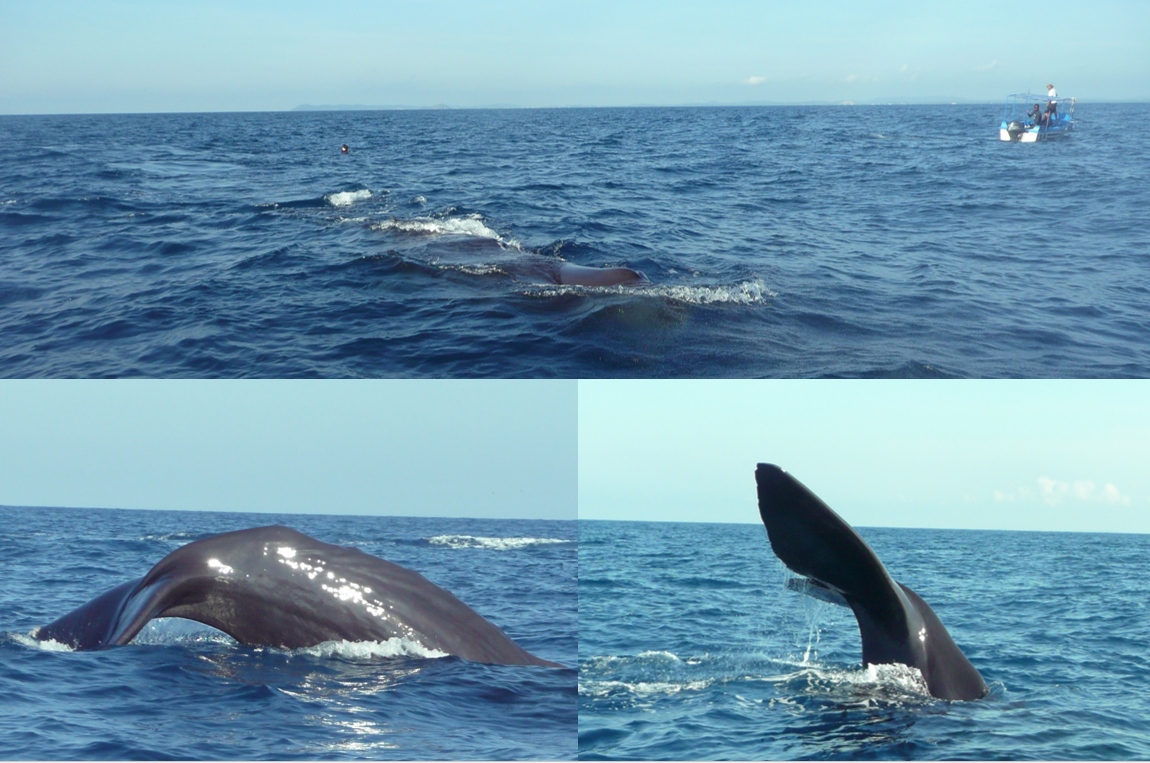
But if torpedoes were as harmless as a sperm whale,
Then would it not be a beautiful world to sail?

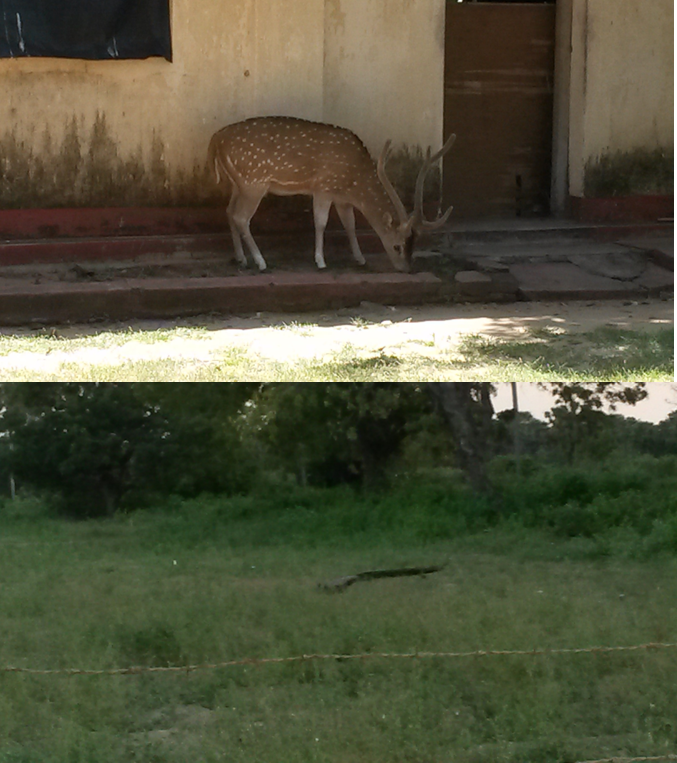
Where else will you find deer grazing so free?
Or a peacock perched by an open tree?
The marvelous mammoth statue of Lord Shiv,
That is inspiration enough for anyone to live.

Thank you Trincomalee for reminding me,
Of the many colours of the sea,
Of the beauty that cannot be painted,
And the miracles that we should not take for granted.


Here are visuals to the verses.


Trincamolee

Beauty that cannot be painted (from verse 1)

Sunrise @ Trincomalee

Saw the Sun emerge from the Trinco sea to share his light (from verse 2)


Full moon over Trincomalee

Moon painting the sea shimmering silver wither her rays (from verse 2)

Sprem whales in Trincamolee

Whale Tale (from verse 6)

Trincamolee

Deer grazing so free, peacock perched by the tree (from verse 7)

Lord Shiva, Koneswaram Temple

The marvelous mammoth statue of Lord Shiv, is inspiration enough for anyone to live (from verse 7)

Last but not least a word on Chaaya Blu,                                                                                                  A staff always smiling and a view so true,                                                                                                   The days passed by, I knew not how my time flew.

Chaaya Blu, Trincomalee

View from Chaaya Blu, Trincomalee

Offer me some wine before you offer to opine

We are oh so eager to offer our opinions,
It helps us nought save make our breath reek like onions.
Especially when we speak on subjects we know of none,
To be satisfied with only shallow minds won.

“Of course there should be a #beefban”
“BBC news! I’m no longer a fan!”
“Did you see the crass roast show from AIB?”
“No, but I am all for never allowing those jerks to pee!”

Thinking ones with the strongest opinions are hailed wise,
We force ourselves to take stands that are nothing but true lies.
For we forget the maxim so pure,
That “Only the stupid are cocksure”

I say, “There is no harm in sitting on a fence
And having a hearty laugh at all this nonsense.”

That’s my opinion on opinions.

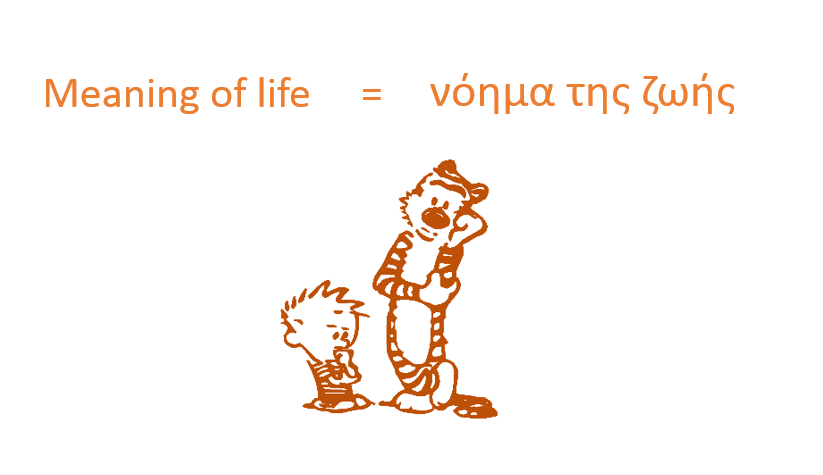
The meaning of ‘meaning of life’

Meaning of Life

“Ya, it’s Greek to me!”

“People have enough to live by but nothing to live for. They have means but no meaning” – Viktor E. Frankl posits in his book ‘Man’s Search for Meaning’. In the book, he narrates his life as an inmate in the Aushwitz Concentration Camp during World War II and his theories on what made some people endure the atrocities and come out alive while so many others just gave up.

He says “Those who have a ‘why’ to live, can bear with almost any ‘how’.” However this ‘why’ is not always an easy answer. This ‘why’ has been a source of existential angst from Siddhartha Gautama to Calvin, not necessarily leading to enlightenment or even peace of mind for most people.

This ‘why’ could be for reasons as varied as love or revenge, accumulating wealth and power or changing the world for the better, fame or family, unabashed hedonism or spiritual enlightenment.

As varied as the reasons could be, we still find people from 7 to 70 wondering what their purpose in life really is. Some even make it their purpose to find their purpose.

But I think obsessing over it isn’t as helpful as obsessing over ‘to be or not to be’ or which lingerie to wear on your date. The attitude that’s helped me not go insane while trying to figure ‘why the fc*!’ am I here’ is to keep looking for the answers but not seeking them, questioning even the most mundane but not getting hung up on finding the answer.

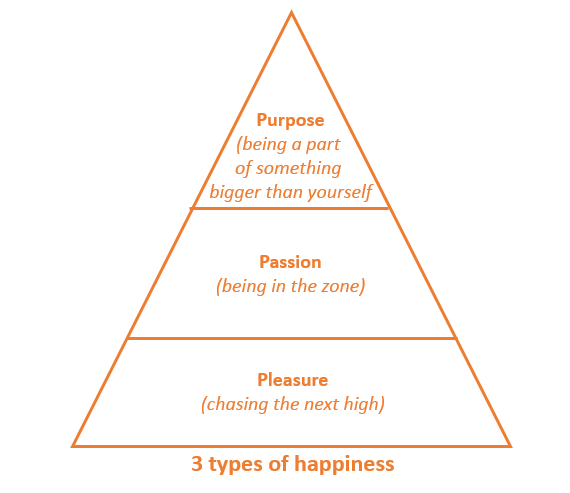
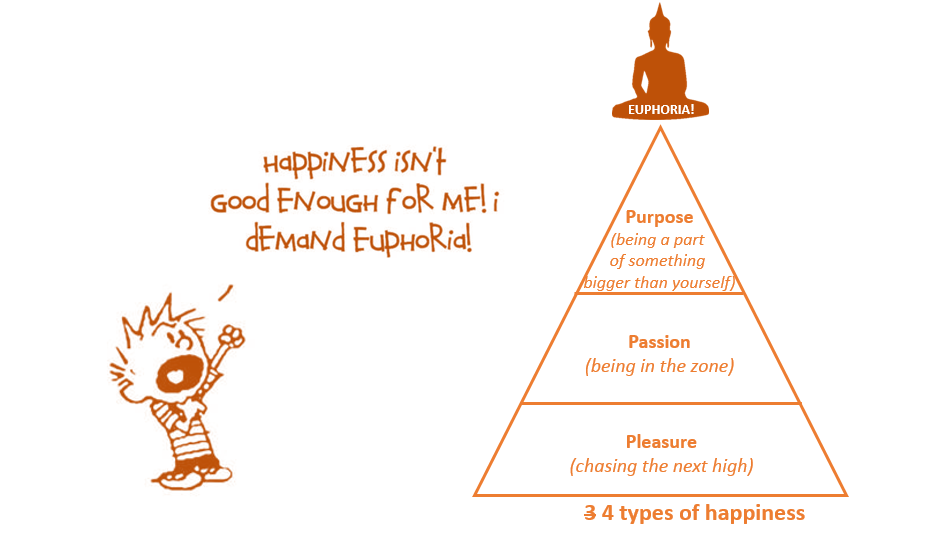
Doing this with an open mind has led me to intuitively traverse Tony Hsieh’s (CEO of www.zappos.com) 3P’s Pyramid which he spells out in his book Delivering Happiness (A book I’d highly recommend for entrepreneurs and all humans too).

According to Tony Hsieh, there are 3 types of happiness or the 3P’s Happiness Pyramid (Fig. 3.pee)


Tony Hsieh's Happiness Framework, 3P's of happiness

Fig. 3.pee

If there’s one thing in common between all the 6 billion homo sapiens in the world, it’s probably that we all have a common purpose of looking for ways to be happy. Unfortunately (or fortunately) I’m no different.

My happiness chasing started at the bottom P for ‘Pleasure’, ‘Pleasure’ being synonymous with girlfriends and money, thinking hedonism is the ‘soul’ purpose of my existence. Soon realization dawned that hedonistic pleasures were all short lived. Like Tony says. “The moment the stimuli goes away, the happiness levels drop immediately. In other words, this type of happiness is the shortest lasting.”

I sensed this even more so in my first corporate role. I was blessed to be working with a company many in my B-school batch would’ve happily traded their porn collection for. I was also blessed with a couple of clients who sucked blood for a living in my first year itself. While I was busy trying to stop the blood sucking, the pleasures were somewhere getting sucked out of my life.

Added to that, I realized that there was no way I could survive more than a leap year reading Gartner and IDC reports (“I barely managed to not flunk my Engineering Exams and now you want me to learn about ‘not so tasty chips’ all over again!”).

Somewhere I became clear that I definitely didn’t want to spend 50% of my waking hours sans passion. I did however love just about everything about movies and music. A little bit of introspection and a little help from the Universe later (she works in mysterious ways, not always like-worthy, in the short run at least), I transitioned to the entertainment industry where I spent a decade ‘not working’. ‘Passion’ outlasted ‘Pleasure’ by 10 years.

The Universe has ways of making the uncomfortable comfortable as well as the comfortable uncomfortable. There was a phase in one of my companies where I was lucky to work under a Hitler incarnate. Even though the experience turned a dream role into a nightmare, I say lucky because it was probably the genesis of my questioning existence.

I became certain I wasn’t born to be a slave. We are all born free and freedom is what we all intuitively seek. Armed with this thought I started my quest for entrepreneurship. Somewhere along this quest it became clear to me that I want to make a difference in as many ways as possible, to attempt to change the world for the better. This ‘Purpose’ has stayed with me and is what drives me to create value in what I’m building.

And if we were to believe Tony Hsieh or Viktor Frankl then this ‘higher-purpose’ (life revolving around something bigger than yourself that has meaning to you) type of happiness is the longest lasting.

While it’s still early days for me, I would tend to agree. This also in no way makes me (or anyone driven by a higher purpose), holier than thou. No pseudo modesty here, it just truly doesn’t! Some of the most interesting people even at seventy have never known why they graced this world. All it means is that the chances of longer lasting happiness is higher if there’s a purpose behind your raison d’être

This also doesn’t mean one needs to live sans ‘Pleasure’ or ‘Passion’. Pleasure will still exist. It just means one needs to question the need to chase ‘Pleasure’. It’s something like what Viktor Frankl quite eloquently describes about ‘success’. He says, “Don’t aim at success. The more you aim at it and make it a target, the more you are going to miss it. For success, like happiness, cannot be pursued; it must ensue, and it only does so as the unintended side effect of one’s personal dedication to a cause greater than oneself or as the by-product of one’s surrender to a person other than oneself. Happiness must happen, and the same holds for success: you have to let it happen by not caring about it.”

It doesn’t end here for me though. Like Calvin says, “Happiness isn’t enough for me, I demand euphoria.”  

Happiness isn't enough for me, enlightenment

Enlightenment the answer to euphoria?

The more I explore, the more it points me in the direction of spiritual enlightenment. Which in simple Pali means finding out ‘Who am I?” and ‘What am I here for?’ So my search for the meaning of ‘meaning of life’ continues. I also suspect this is the mother of all ‘Meaning of Life’. If we can find the answer to this then…

And the 2015 non-Grammy winners are…

There’s more to the Grammys than meets the ears. I mean there’s a ‘shazam’ of music and talent that doesn’t get any Grammy love. Can’t really fault the Grammy Academy though. There has to be a cut off somewhere, right?

I on the other hand don’t have any obligations or desire to chop or rank. So I’m sharing some of the music albums from outside the Grammy list (that haven’t been nominated either!), in no particular order, that I’m happy I stumbled upon.

I’ve listed my favourite albums from last year (with artists in the brackets) and linked my favourite tracks from the albums. Give them a listen. After all, “Where words fail, music speaks.” – Hans Christian Anderson


  1. Queen of the Clouds (Tove Lo) – You’ll Love Tove. Love her ‘Habits’, her ‘Moments’, her ‘Talking Body’ and even her ‘Gun’

Strange Desire (Bleachers) – Throwback to the 80s music, how can I not like it!

  1. I Never Learn (Lykke Li) – She’s being humble here. I think she’s learning pretty well.

  1. Don’t Kill the Magic (MAGIC!) – I believe in MAGIC too.

5.  Islands (Bear’s Den) – I guess if Mumford & Sons were to blend with Of Monsters & Men, it would sound something like this. Happy to take a holiday on these Islands any day.

  1. Fault in our Stars OST (Various Artists) – There’s no fault in these stars at all. My favourite album from 2014.

  1. Begin Again OST (Various Artists) – That’s exactly what I did, after listening to the album.

Bonus tracks: Throwing in a couple one hit wonders

1. Come With Me Now (Kongos) – The accordion does it for me!

2. Prayer in C (Lily Wood & The Prick & Robin Schultz) – For purists out there, listen to the original and then this remix.

So what else got missed. Share some tracks/artists/albums that rocked you last year.

Love: Is it in the heart or the head?

Mid Week Geek Peek #3

Bird Love

We are not in it alone. Even birds sometimes don’t want to see each others face.

Have you ever wondered why you feel attracted to one person while in love with someone else? Questioned if then the love was true love? Or worse, get distraught when the passion wanes and ask if it was love in the first place? In fact why do we love at all?

Well, I have… asked these questions. For a long time I just tried to find the answers through polite conversations with the demons in my head. That never helps, the polite conversations, right? But “when the student is ready, the teacher does appear.” So Helen Fisher appeared, in eBook format.

In her book “Why We Love”, Helen Fisher clinically dissects ‘love’ as we know it (or don’t know it), helping me quieten the demons (at least some of them), in my head…and I suspect in many other heads too.

She starts her conversation by listing the symptoms of love. (Yeah! like we need a doctor to diagnose matters of the heart). But I guess she had to start somewhere. She explains that ‘romantic love’ is a universal feeling produced by specific chemicals and networks in the brain’. For the geeks out there:

  • Dopamine – Elevated levels of dopamine in the brain produce extremely focussed attention as well as unwavering motivation and goal directed behaviours. These are central characteristics of romantic love – they intensely focus on the beloved, almost to the point of excluding all else, focus on positive qualities, ignore negative.
  • Norepinephrine’s High – A chemical derived from dopamine, may also contribute to a lover’s high. Increasing levels of this stimulant generally produce exhilaration, excessive energy, sleeplessness and loss of appetite – some of the basic characteristics of love. This could also explain why the lover can remember the smallest details of the beloved’s actions and cherished moments spent together.
  • Serotonin – Lover’s persistent, involuntary, irresistible ruminations about a sweetheart may be associated with low level of some type of serotonin. (Obsessive thinking)

But what’s the point in getting all geeky (apart from showing off!). The point being that because the passion emanates from these chemicals, primarily dopamine, motivation and goal oriented behaviour are involved.

Which in simple Klingon means… romantic love is a primary motivation system in the brain – in short, fundamental human mating drive. And like drives –

  • Romantic attraction is tenacious; it is very difficult to extinguish. Emotions on the other hand, come and go, you can be happy in the morning and angry in the afternoon.
  • Romantic love is focussed on a specific reward, the beloved, in the same way hunger is focussed on food.
  • Romantic love is a need, a craving. We need food. We need water. We need warmth. And the lover feels he/she needs the beloved.

So we (broadly) know ‘why we love’ But why does it get so complicated?

She simplifies it by breaking up this ‘mating drive’ into 3 categories –

  1. Lust (craving for sexual gratification) – Lust evolved to motivate individuals to seek sexual union with almost any semi-appropriate partner.
  2. Romantic love – Romantic love emerged to drive men and women to focus their mating attention on a preferred individual, thereby preserving invaluable courtship time and energy. Pair bonding also became essential to raise the off springs resulting in monogamy. They stayed together for 4 years to raise child to infancy, then parted to bear off springs with different partners, which is also probably the evolution of divorce.
  3. Attachment (the feeling of calm, security, and union with a long term partner) – Love changes over time. It becomes deeper, calmer. No longer couples talk all day or ‘dance all night’. The mad passion, the ecstasy, the longing, the obsessive thinking, the heightened energy: all dissolve. But if you’re fortunate, this magic transforms itself into new feelings of security, comfort, calm and union with your partner. There’s a Brazilian saying “Love is born in a glance and matures in a smile”

She agrees however that it may not be that ‘simple’ a relationship. The fact that lust, romantic love and attachment can ignite in any combination makes it ‘It’s complicated’ (and fun?). She says

‘Many of us have periods in our lives when these three mating drives do not focus on the same person. It seems to be the destiny of humankind that we are neurologically able to love more than one person at a time. You can feel profound attachment for a long-term spouse, while you feel romantic passion for someone in the office or your social circle, while you feel the sex drive while you read a book, watch a movie or do something else unrelated to either partner. You can even swing from one feeling to another.’

Yup. That spells fun!

But don’t get all excited people. This doesn’t give you the license for polyamory. Even though polyamory seems logically utopian, she argues that it is impractical – “humankind does not share love gracefully. ‘We are jealous people’ Polyamorous couples not surprisingly spend many hours every week sorting out their feelings of possessiveness and jealousy.”

What’s the solution then for happily ever after?

How do you ignite mad romantic passion in another and sustain it? Especially when nature had designed not a 7 year itch but a 4 year itch?

Helen Fisher’s fundamental tip for ‘forever after’ is to do novel things together. Adventurous stuff increases adrenalin – increases dopamine – increases passion. If your relationship needs a prescription or if you’re simply curious, read her book for other possible solutions for ‘everlasting love’ or simply just to understand this cruelly beautiful emotion that seemingly cannot be tamed.

I on the other hand don’t think there is any universal solution. Each individual and each individual couple needs to explore for themselves what works with all honesty, ‘wanting’ to be together but not ‘needing’ to be together. If anything, explore the possibility of a ‘higher state of love without expectations in the spiritual realm of things’

But then what do I know? Why don’t you share what’s worked for you to keep the magic alive in a not so fairy tale world where the beast may not become a prince.

Principles by Ray Dalios

Mid-Week Geek Peek #2

“Above all else, I want you to think for yourself—to decide                                                                         1) what you want,                                                                                                                                           2) what is true and                                                                                                                                          3) what to do about it.

I want you to do that in a clear-headed thoughtful way, so that you get what you want. I wrote this book to help you do that. “

Ray Dalios is an American businessman and founder of the world’s biggest hedge fund, Bridgewater Associates, with $160 billion in assets. But that’s not why I’ve become a big fan of Ray. I’ve become a big fan because of the “different kind of company” he has created.

Unlike other hedge funds that climb the skyscrapers of Wall Street, Bridgewater Associates

Bridgewater Associates

Workplace or Retreat?

headquarters, located in Westport, Connecticut, is described as retreat-like and is surrounded by the trees of a former nature reserve.

Bridgewater is perceived as almost cult like and he attributes its success to its people and culture. A culture that’s built around what Ray Dalio calls ‘radical transparency’ to the point where cynics call the workplace creepy.

Creepy or not (Bridgewater is under constant surveillance – all meetings, all interviews and all interactions are taped), clearly his practice and philosophy is working.

And his philosophy is what he spells out through over 200 principles that Dalio shares with the hope that it will help not only his employees, but anyone interested in achieving success inside or outside the workplace.

But then what is success?

Dalio’s version of success is: “I believe that it is nothing more than getting what you want—and that it is up to you to decide what that is for you. I don’t care whether it’s being a master of the universe, a couch potato, or anything else—I really don’t. What is essential is that you are clear about what you want and that you figure out how to get it.”

This “success is achieved by people who deeply understand reality and know how to use it to get what they want. The converse is also true: idealists who are not well-grounded in reality create problems, not progress.”

He breaks up his book into 3 distinct parts that can be read either independently or as a connected whole.

Part 1 is about the purpose and importance of having principles in general,

Dalio believes that having principles that work is essential for getting what we want out of life. He also believes that to understand each other we have to understand each other’s principles. He begins by examining the following questions –

1) What are principles?                                                                                                                                2) Why are principles important?                                                                                                               3)  Where do principles come from?                                                                                                          4)  Do you have principles that you live by? What are they?                                                                 5) How well do you think they will work and why?

While taking you through his internal journey and philosophy, he urges you to answer these questions by yourself and when considering each principle, please ask yourself, “Is it true?”

Part 2 explains Dalio’s most fundamental life principles that apply to everything he does.

Very early in his life Dalio learned how important and how liberating it was to think for himself. He developed an approach for himself that he believes will work for you to accomplish great things. Dalio’s approach was –

1) I worked for what I wanted, not for what others wanted me to do

2)  I came up with the best independent opinions I could muster to get what I wanted

3) I stress-tested my opinions by having the smartest people I could find challenge them so I could find out where I was wrong.

4) I remained wary about being overconfident, and I figured out how to effectively deal with my not knowing.

5) I wrestled with my realities, reflected on the consequences of my decisions, and learned and improved from this process

This led him to his most fundamental principle: Truth —more precisely, an accurate understanding of reality— is the essential foundation for producing good outcomes.

He further talks about the 5 choices we need to make as we head towards our goal and his 5 step process to getting what you want out of life.

Part 3, explains his management principles as they are being lived out at Bridgewater. There are over 200 of them logically broken down. Some of my favourites, that transcend into life as well, in random order are –

  1. Trust in truth – realize that you have nothing to fear from truth
  2. Don’t worry about looking good – worry about achieving your goals
  3. Be assertive and open minded at the same time
  4. Recognize that conflicts are essential for great relationships because they are the means by which people determine whether their principles are aligned and resolve their differences.
  5. Recognize that people are built very differently
  6. Don’t act before thinking. Take the time to come up with a game plan
  7. Logic, reason, and common sense must trump everything else in decision-making. However, while logic drives our decisions, feelings are very relevant
  8. Avoid the “theoretical should”
  9. Embrace the power of asking: “What don’t I know, and what should I do about it?”
  10. Remember that your goal is to find the best answer, not to give the best one you have

Like most people who’ve made their billions, Dalio didn’t set out chasing the number of zeroes.

“Yes, I started Bridgewater from scratch, and now it’s a uniquely successful company and I am on the Forbes 400 list. But these results were never my goals—they were just residual outcomes—so my getting them can’t be indications of my success. And, quite frankly, I never found them very rewarding. What I wanted was to have an interesting, diverse life filled with lots of learning—and especially meaningful work and meaningful relationships. I feel that I have gotten these in abundance and I am happy. And I feel that I got what I wanted by following the same basic approach I used as a 12-year-old caddie trying to beat the market”

 “Principles by Ray Dalio” is his approach and fundamental principles he learnt along the way, elaborated in this gem of a manifesto (if I can call it so) for not only anyone building a company, but also for everyone looking for answers to live a better and more “successful” life.

Do you have any life principles? What’s your definition of success?

Liberation from Expectations

How we toil through our lives,
Trying to please father, mother and wives,
How we wait for the day
For those magic words, dare I say! 

“I am so proud of you”
Those words may be few,
Yet the joy that we feel
Makes all our sorrows heal.

But do be careful, cos little do we know
The futility of the smiles we try to bestow,
The very road to fulfil another’s expectations,
Is the same that leads to heart wrenching consternation.

Let us think not about pleasing another
And maybe our life might be with a little less bother.