Author Archives: sandeepdotburman

And the 2015 non-Grammy winners are…

There’s more to the Grammys than meets the ears. I mean there’s a ‘shazam’ of music and talent that doesn’t get any Grammy love. Can’t really fault the Grammy Academy though. There has to be a cut off somewhere, right?

I on the other hand don’t have any obligations or desire to chop or rank. So I’m sharing some of the music albums from outside the Grammy list (that haven’t been nominated either!), in no particular order, that I’m happy I stumbled upon.

I’ve listed my favourite albums from last year (with artists in the brackets) and linked my favourite tracks from the albums. Give them a listen. After all, “Where words fail, music speaks.” – Hans Christian Anderson


  1. Queen of the Clouds (Tove Lo) – You’ll Love Tove. Love her ‘Habits’, her ‘Moments’, her ‘Talking Body’ and even her ‘Gun’

https://www.youtube.com/watch?v=kvZcBCwhI1M

Strange Desire (Bleachers) – Throwback to the 80s music, how can I not like it!

  1. I Never Learn (Lykke Li) – She’s being humble here. I think she’s learning pretty well.
  1. Don’t Kill the Magic (MAGIC!) – I believe in MAGIC too.

5.  Islands (Bear’s Den) – I guess if Mumford & Sons were to blend with Of Monsters & Men, it would sound something like this. Happy to take a holiday on these Islands any day.

  1. Fault in our Stars OST (Various Artists) – There’s no fault in these stars at all. My favourite album from 2014.
  1. Begin Again OST (Various Artists) – That’s exactly what I did, after listening to the album.

Bonus tracks: Throwing in a couple one hit wonders

1. Come With Me Now (Kongos) – The accordion does it for me!

2. Prayer in C (Lily Wood & The Prick & Robin Schultz) – For purists out there, listen to the original and then this remix.

So what else got missed. Share some tracks/artists/albums that rocked you last year.

I wish I had met Mark Twain

“A man who doesn’t read has no advantage over a man who can’t read” – Mark Twain #MondayMorningWakeUpCall

As obvious as this seems, I don’t think this is so obvious.

And reading the newspaper doesn’t count here. If anything I believe if newspapers were banned it would make the world a better place.

Does it really matter? I mean reading? Does it help in any way once we leave the ‘learning’ era of our school and college days? I don’t think I can get away by making sweeping aphorisms like Mark Twain, but I can speak for myself.

For one, I believe if we live in the delusional world where learning stops on graduation day then we will soon celebrate graduation day as dooms day.

In college I hoped that to be the case. Graduation day meant no longer having to pour through books to make sure I don’t flunk exams. But little did I know that life itself was a mega-exam inundated with pop quizzes every single day. Both professional and personal life bowling googlies.

The funny thing is, even though there have been no score sheets, I, and I suspect many out there, still want to score well. While the benchmark and the parameters of scoring well vary from individual to individual, my simplistic measure is ‘am I stagnating’ professionally or ‘am I any wiser’ on the personal front.

Life experiences make even people living with their eyes wide shut wiser, but we can’t and don’t want to experience all possible permutations and combinations of life. Exposing myself to varied reading (and lots of pop culture) has helped me understand more about life, the universe and everything more than Arthur Dent could do so even by Hitchhiking through the Galaxy. While I’m a far cry from being wise, a claim which only Yoda and the haloed enlightened deserve, it has definitely given me ammunition to fight the demons in my head and the strength to be myself.

Similarly, I can’t over emphasize the confidence reading has instilled in me to stay true to my vision professionally. In fact sometimes I even wonder how some people get through an entire lifetime with learning only ‘on the job’. It is quite possible that they would be naturally quite insightful, a talent I’m probably lucky not to have, but I think I would’ve gotten along with Mark Twain better than them.

What are working for?

Are we grooming for life or are we brooming for life #MondayMorningWakeUpCall

And God said to Adam “By the sweat of thy brow you will eat your food until you return to the ground, since from it you were taken”

But did he really say it? (I’ve so far had luck with mostly one sided conversations with the invisible almighty)

Are we really meant to toil day and night and night and day only to swallow what we’re going to excrete the next day? While I’m ‘hyperboling’ here, it doesn’t seem too far from reality where we spend our lives toiling in vain to make the impermanent permanent.

What is worse is that it doesn’t end with self-flagellation. I still see so many parents whiplash (maybe not literally, but you get the idea) their kids with the intent of grooming them to enslave the holy trinity (Money, Power, Fame) when in reality it is they/we who become the slaves with a broom.

So I do think it’s worth taking a step back to ponder why we are working like slaves (if we are) only for joys (which we think are joys) which are ephemeral, if not for us, at least for the innocent ones.

Freedom sans a Constitution

Freedom isn’t free. It comes with a constitution. Maybe a necessary one? #MondayMorningWakeUpCall

We celebrate Republic Day to honour the date on which the Constitution of India came into force completing the country’s transition to becoming an independent republic. But are we truly free?

Free from corruption, prejudice, orthodoxy.

Or worse, at an individual level, free from greed, anger, envy, jealousy, ambition, insecurity, pride, fear, hate and love?

Along with freeing our mind from limits, wouldn’t it be great if weren’t a slave to any emotion bad or good? Wouldn’t it be great if we could just FREE OUR MIND? Period. And then maybe we can aspire to live in a world where an independent republic doesn’t even need a fancy rule book called Constitution. Imagine!

Love: Is it in the heart or the head?

Mid Week Geek Peek #3

Bird Love

We are not in it alone. Even birds sometimes don’t want to see each others face.

Have you ever wondered why you feel attracted to one person while in love with someone else? Questioned if then the love was true love? Or worse, get distraught when the passion wanes and ask if it was love in the first place? In fact why do we love at all?

Well, I have… asked these questions. For a long time I just tried to find the answers through polite conversations with the demons in my head. That never helps, the polite conversations, right? But “when the student is ready, the teacher does appear.” So Helen Fisher appeared, in eBook format.

In her book “Why We Love”, Helen Fisher clinically dissects ‘love’ as we know it (or don’t know it), helping me quieten the demons (at least some of them), in my head…and I suspect in many other heads too.

She starts her conversation by listing the symptoms of love. (Yeah! like we need a doctor to diagnose matters of the heart). But I guess she had to start somewhere. She explains that ‘romantic love’ is a universal feeling produced by specific chemicals and networks in the brain’. For the geeks out there:

  • Dopamine – Elevated levels of dopamine in the brain produce extremely focussed attention as well as unwavering motivation and goal directed behaviours. These are central characteristics of romantic love – they intensely focus on the beloved, almost to the point of excluding all else, focus on positive qualities, ignore negative.
  • Norepinephrine’s High – A chemical derived from dopamine, may also contribute to a lover’s high. Increasing levels of this stimulant generally produce exhilaration, excessive energy, sleeplessness and loss of appetite – some of the basic characteristics of love. This could also explain why the lover can remember the smallest details of the beloved’s actions and cherished moments spent together.
  • Serotonin – Lover’s persistent, involuntary, irresistible ruminations about a sweetheart may be associated with low level of some type of serotonin. (Obsessive thinking)

But what’s the point in getting all geeky (apart from showing off!). The point being that because the passion emanates from these chemicals, primarily dopamine, motivation and goal oriented behaviour are involved.

Which in simple Klingon means… romantic love is a primary motivation system in the brain – in short, fundamental human mating drive. And like drives –

  • Romantic attraction is tenacious; it is very difficult to extinguish. Emotions on the other hand, come and go, you can be happy in the morning and angry in the afternoon.
  • Romantic love is focussed on a specific reward, the beloved, in the same way hunger is focussed on food.
  • Romantic love is a need, a craving. We need food. We need water. We need warmth. And the lover feels he/she needs the beloved.

So we (broadly) know ‘why we love’ But why does it get so complicated?

She simplifies it by breaking up this ‘mating drive’ into 3 categories –

  1. Lust (craving for sexual gratification) – Lust evolved to motivate individuals to seek sexual union with almost any semi-appropriate partner.
  2. Romantic love – Romantic love emerged to drive men and women to focus their mating attention on a preferred individual, thereby preserving invaluable courtship time and energy. Pair bonding also became essential to raise the off springs resulting in monogamy. They stayed together for 4 years to raise child to infancy, then parted to bear off springs with different partners, which is also probably the evolution of divorce.
  3. Attachment (the feeling of calm, security, and union with a long term partner) – Love changes over time. It becomes deeper, calmer. No longer couples talk all day or ‘dance all night’. The mad passion, the ecstasy, the longing, the obsessive thinking, the heightened energy: all dissolve. But if you’re fortunate, this magic transforms itself into new feelings of security, comfort, calm and union with your partner. There’s a Brazilian saying “Love is born in a glance and matures in a smile”

She agrees however that it may not be that ‘simple’ a relationship. The fact that lust, romantic love and attachment can ignite in any combination makes it ‘It’s complicated’ (and fun?). She says

‘Many of us have periods in our lives when these three mating drives do not focus on the same person. It seems to be the destiny of humankind that we are neurologically able to love more than one person at a time. You can feel profound attachment for a long-term spouse, while you feel romantic passion for someone in the office or your social circle, while you feel the sex drive while you read a book, watch a movie or do something else unrelated to either partner. You can even swing from one feeling to another.’

Yup. That spells fun!

But don’t get all excited people. This doesn’t give you the license for polyamory. Even though polyamory seems logically utopian, she argues that it is impractical – “humankind does not share love gracefully. ‘We are jealous people’ Polyamorous couples not surprisingly spend many hours every week sorting out their feelings of possessiveness and jealousy.”

What’s the solution then for happily ever after?

How do you ignite mad romantic passion in another and sustain it? Especially when nature had designed not a 7 year itch but a 4 year itch?

Helen Fisher’s fundamental tip for ‘forever after’ is to do novel things together. Adventurous stuff increases adrenalin – increases dopamine – increases passion. If your relationship needs a prescription or if you’re simply curious, read her book for other possible solutions for ‘everlasting love’ or simply just to understand this cruelly beautiful emotion that seemingly cannot be tamed.

I on the other hand don’t think there is any universal solution. Each individual and each individual couple needs to explore for themselves what works with all honesty, ‘wanting’ to be together but not ‘needing’ to be together. If anything, explore the possibility of a ‘higher state of love without expectations in the spiritual realm of things’

But then what do I know? Why don’t you share what’s worked for you to keep the magic alive in a not so fairy tale world where the beast may not become a prince.

Limits

Limits are only in your mind, not your legs (or anywhere else) #MondayMorningWakeUpCall

Mumbai Marathon

And if Eastern philosophy is to be believed, the mind doesn’t exist, ergo, limits don’t exist. But let’s not go where we mortals have not gone (yet). Just ask your Marathon running friends from yesterday’s Mumbai Marathon and they will vouch for the same, irrespective of age, gender or colour of blood.

So let’s go ahead and FREE OUR MINDS, from fear, doubts, disbelief… and LIMITS!

Principles by Ray Dalios

Mid-Week Geek Peek #2

“Above all else, I want you to think for yourself—to decide                                                                         1) what you want,                                                                                                                                           2) what is true and                                                                                                                                          3) what to do about it.

I want you to do that in a clear-headed thoughtful way, so that you get what you want. I wrote this book to help you do that. “

Ray Dalios is an American businessman and founder of the world’s biggest hedge fund, Bridgewater Associates, with $160 billion in assets. But that’s not why I’ve become a big fan of Ray. I’ve become a big fan because of the “different kind of company” he has created.

Unlike other hedge funds that climb the skyscrapers of Wall Street, Bridgewater Associates

Bridgewater Associates

Workplace or Retreat?

headquarters, located in Westport, Connecticut, is described as retreat-like and is surrounded by the trees of a former nature reserve.

Bridgewater is perceived as almost cult like and he attributes its success to its people and culture. A culture that’s built around what Ray Dalio calls ‘radical transparency’ to the point where cynics call the workplace creepy.

Creepy or not (Bridgewater is under constant surveillance – all meetings, all interviews and all interactions are taped), clearly his practice and philosophy is working.

And his philosophy is what he spells out through over 200 principles that Dalio shares with the hope that it will help not only his employees, but anyone interested in achieving success inside or outside the workplace.

But then what is success?

Dalio’s version of success is: “I believe that it is nothing more than getting what you want—and that it is up to you to decide what that is for you. I don’t care whether it’s being a master of the universe, a couch potato, or anything else—I really don’t. What is essential is that you are clear about what you want and that you figure out how to get it.”

This “success is achieved by people who deeply understand reality and know how to use it to get what they want. The converse is also true: idealists who are not well-grounded in reality create problems, not progress.”

He breaks up his book into 3 distinct parts that can be read either independently or as a connected whole.

Part 1 is about the purpose and importance of having principles in general,

Dalio believes that having principles that work is essential for getting what we want out of life. He also believes that to understand each other we have to understand each other’s principles. He begins by examining the following questions –

1) What are principles?                                                                                                                                2) Why are principles important?                                                                                                               3)  Where do principles come from?                                                                                                          4)  Do you have principles that you live by? What are they?                                                                 5) How well do you think they will work and why?

While taking you through his internal journey and philosophy, he urges you to answer these questions by yourself and when considering each principle, please ask yourself, “Is it true?”

Part 2 explains Dalio’s most fundamental life principles that apply to everything he does.

Very early in his life Dalio learned how important and how liberating it was to think for himself. He developed an approach for himself that he believes will work for you to accomplish great things. Dalio’s approach was –

1) I worked for what I wanted, not for what others wanted me to do

2)  I came up with the best independent opinions I could muster to get what I wanted

3) I stress-tested my opinions by having the smartest people I could find challenge them so I could find out where I was wrong.

4) I remained wary about being overconfident, and I figured out how to effectively deal with my not knowing.

5) I wrestled with my realities, reflected on the consequences of my decisions, and learned and improved from this process

This led him to his most fundamental principle: Truth —more precisely, an accurate understanding of reality— is the essential foundation for producing good outcomes.

He further talks about the 5 choices we need to make as we head towards our goal and his 5 step process to getting what you want out of life.

Part 3, explains his management principles as they are being lived out at Bridgewater. There are over 200 of them logically broken down. Some of my favourites, that transcend into life as well, in random order are –

  1. Trust in truth – realize that you have nothing to fear from truth
  2. Don’t worry about looking good – worry about achieving your goals
  3. Be assertive and open minded at the same time
  4. Recognize that conflicts are essential for great relationships because they are the means by which people determine whether their principles are aligned and resolve their differences.
  5. Recognize that people are built very differently
  6. Don’t act before thinking. Take the time to come up with a game plan
  7. Logic, reason, and common sense must trump everything else in decision-making. However, while logic drives our decisions, feelings are very relevant
  8. Avoid the “theoretical should”
  9. Embrace the power of asking: “What don’t I know, and what should I do about it?”
  10. Remember that your goal is to find the best answer, not to give the best one you have

Like most people who’ve made their billions, Dalio didn’t set out chasing the number of zeroes.

“Yes, I started Bridgewater from scratch, and now it’s a uniquely successful company and I am on the Forbes 400 list. But these results were never my goals—they were just residual outcomes—so my getting them can’t be indications of my success. And, quite frankly, I never found them very rewarding. What I wanted was to have an interesting, diverse life filled with lots of learning—and especially meaningful work and meaningful relationships. I feel that I have gotten these in abundance and I am happy. And I feel that I got what I wanted by following the same basic approach I used as a 12-year-old caddie trying to beat the market”

 “Principles by Ray Dalio” is his approach and fundamental principles he learnt along the way, elaborated in this gem of a manifesto (if I can call it so) for not only anyone building a company, but also for everyone looking for answers to live a better and more “successful” life.

Do you have any life principles? What’s your definition of success?

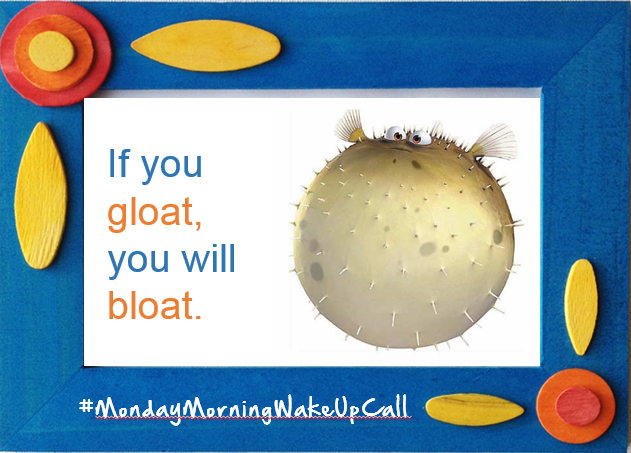
Gloating

If you gloat you might bloat #MondayMorningWakeUpCall

Gloat, bloat, Monday morning wake up callLike Pinocchio’s nose used to grow longer every time he lied, why isn’t there a character who literally bloats every time he/she gloats? I’m sure there’s a fun story with a life lesson for adults somewhere there.

On second thoughts I kinda wish that instead of a story it happens in reality, even Pinocchio.


Liberation from Expectations

How we toil through our lives,
Trying to please father, mother and wives,
How we wait for the day
For those magic words, dare I say! 

“I am so proud of you”
Those words may be few,
Yet the joy that we feel
Makes all our sorrows heal.

But do be careful, cos little do we know
The futility of the smiles we try to bestow,
The very road to fulfil another’s expectations,
Is the same that leads to heart wrenching consternation.

Let us think not about pleasing another
And maybe our life might be with a little less bother.