Author Archives: sandeepdotburman

The potty of gold

Why chase a phantasmal pot when you can be a zot #MondayMorningWakeUpCall

Sing even if you can’t sell your songs

Paint even if there’s no one to purchase your paintings

Love even if it is a love that is lost

Write even if no one reads your rhymes

Race even if you reap no rewards

Once you experience the joy of singing, painting, loving, writing, racing, doing just about anything simply for the love of it, you lose yourself in your labour. It is when you become one with your vocation and time ceases to exist.

And when you experience the magic of oneness, it’s unlikely that you will crave the phantasmal pot of gold at the end of the rainbow. Which sometimes even turns out to be more like a potty of gold.

The rainbow itself becomes the reward.

Going from Zer0 to 0ne

The more we compete, the less we gain – Peter Thiel #MondayMorningWakeUpCall

Zero to One

Blue Apples – They not only keep the doctor away, you will also never have to brush a single day

Pop Quiz: What’s common between driving in traffic and driving a startup?

Answer: If you can pull yourself away from the crowd, your speed (and probability) of reaching the destination on time becomes (exponentially) higher. And what’s more, it comes sans the stress of a rat race.

The epiphany came to me when I was on my way to Pune last week, reading ‘Zer0 to 0ne’ by Peter Thiel (Paypal Co-founder) during the drive. In a particular section of the book Peter talks about the benefits of building a monopolistic company, which is, a company building so much value in its niche that it literally rules the market. This is in contrast to building a company in a crowded space amidst cut-throat competition by just re-packaging the same offerings, which is more likely to lead to everyone (or at least most) losing in the long run and sometimes even the short run.

Much like driving sans traffic vis-à-vis bumper traffic as I fathomed during my journey experience in my drive to Pune. For a change, I managed to leave well on time, at 7am, well ahead of the rush hour. I not only cut down my usual travel time by an hour (30%) by pulling myself away from the rush hour crowd, I also not once had stressed out during the journey to make time. Instead I soaked in the lush green scene en route and daydreamed about how to take Skillzot from 0 to 1.

To explain this simply, instead of fighting for apples from the same tree where half a dozen people are pulling each other’s hair and moustache to grab the most succulent apples, why not you plant an apple tree that gives blue apples, apples that will keep the doctor away, and, you can also promise your customer that she will never have to brush a single day.

Of course you could argue that making blue apples isn’t easy, maybe even impossible. But then again, is competing with blunt daggers any less difficult?

The idea here is that competing in a crowded market will at best lead to only incremental benefits. You can pull yourself exponentially ahead of a crowded market by creating new things that will make the future not just different, but better – to go from 0 to 1.

I got news for you!

Sun is shining and so are you #MondayMorningWakeUpCall

Axwell & Ingrosso, members of erstwhile Swedish House Mafia, seem to be making a habit of belting out galvanizing high energy EDM songs to stir us and spur us on to “Come out and play”. Right from their Swedish House Mafia days of ‘Don’t You Worry Child” to “Save The World” to the current ones in their new duo avatar – “Something New” and their latest “Sun Is Shining”, it seems to be more by design then by accident.

Whether it’s by design because they see world changing possibilities by way of individual change through music or because it makes for better business or a combination of both it, I’m not nit-picking. As long as it aligns itself with a greater cause of ‘waking up people on Monday mornings’ (or what the heck, any morning for that matter), I’m a fan.

Thank you Axwell & Ingrosso for your unwitting support to #MondayMorningWakeUpCall J

Out with doubt I say!

Doubt kills more dreams than failure ever will – Suzy Kassem #MondayMorningWakeUpCall

There are monsters in our head. And demons. And devils. And they all come in the guise of doubt, self-doubt. Unlike Monster’s Inc.’s Sulley, they don’t scare because they care. They scare because they love to see our souls lost in the dare. They don’t fight fair. They kill our dreams and replace it with nightmare.

Mythology is packed with stories to corroborate that every demon has a weakness. They can be and surely are ultimately vanquished. Yes, if you want, the demons in your head can be dead. To kill them all you need to do is pretend you can’t hear them. They cease to exist if you ignore them.

Like love grows with every heartbeat, the demons grow with every chat and tweet. The more you get into debate, the more they will control your fate. If however you do not reciprocate, you can pick their funeral date. You render them forever extinct, when you curb your fight instinct.

Like most simple truths, this is also easier said than done. It’s as difficult not to engage with the ‘doubt demons’ as it is with Rooney Mara in a state of undress. Here’s a trick I learnt (still learning) to ignore the doubt demons (I have no intention of ignoring Rooney Mara J). Whenever they scream for your attention, pay attention to your breath, watch it go in, watch it go out, while the demons scream and shout. In time, their voices will go bust, the demons will die a painful death and go back to dust.

Here’s to ‘dream on’, while the demons are gone.

The parental claws in rebel with a cause

“Parents can only give good advice or put them on the right paths, but the final forming of a person’s character lies in their own hands.” – Anne Frank #MondayMorningWakeUpCall

Would you –

  1. Marry someone you didn’t want to because your parents pressured you to?
  2. Or worse, not marry someone you loved because your parents pressured you to?
  3. Take up a job you hated or worse, didn’t take up a job you thought was your calling because your parents pressured you to?
  4. Accept dowry because your parents pressured you to?
  5. Stop hanging out with your best friend forever because your parents pressured you to?
  6. Consented to your younger sister’s child marriage or female infanticide or ‘sati’ because your parents pressured you to?
  7. Shied away from divorce and stayed in a dead marriage because your parents pressured you to?
  8. Wound someone physically or in any other way because your parents pressured you to?
  9. Choose the clothes you wore, the food you ate, the movies you watched, lived by your parent’s rules even if they were contrary to what you wished because your parents pressured you to?
  10. Didn’t do what you know is best for you because your parents thought otherwise?

The list of questions can be endless. Some of the answers are I hope an easy ‘no’ cos they are punishable by law (they weren’t once upon a time). Some of the answers I gather are not so easily negative for many.

I understand that the bond between you and your parents is precious and pure. That they have toiled the better part of their lives for your well-being. That they care about you more than they care about themselves and hence look out for what’s best for you.

But what if they don’t know what’s best for you? What if there is a drop in the ocean chance that they are acting out of selfish interest or out of plain ignorance? If it is a crime to witness a crime and turn a blind eye, then isn’t it also a crime to abet actions that may not lead to what is best for you or worse, acquiesce to actions that may harm you?

I recently chanced upon life’s unspoken agreement between parents and children. It hasn’t been made available to the public. Apparently you’ve got to discover it yourself, without any maps or apps! While the real understanding happens in discovering it yourself, till such time that happens, I’m sharing excerpts from a parental clause that releases you from the loving shackles of what at times can become parental claws.

Clause number 21.0 says and I quote “If you were to rebel, with a cause, and it must be with a cause, against the wishes or demands of your parents, and the cause be a cause that you think would be in your best interest, and that you have checked your official birth certificate and have found yourself to have crossed the legal drinking age in your country (or what the heck, any country’s minimal legal age is applicable here) then you can guilt free pursue your cause as you deem best for you. Santa will even send you an extra present for your bravery.”

To add my two bits, I’ve usually found parents, over time, to see their child’s perspective. And with age, they also tend to forget (and even forgive). I do agree time sometimes moves a bit slower than you would wish it to, but Santa’s ‘be naughty’ Clause assures you, combating the parental pressure, will reward you with glorious treasure (or at least extra presents from Santa).

However, if you want to hide behind the veil of ‘parental pressure’ and not take ownership of your actions and decisions, then either you are not being fair to your parents or you would do well to educate your parents on English poet John Dryden’s aphorism “The sooner you treat your son as a man, the sooner he will be one.” (and daughter will be a woman)


Why run when we can leap?

All the good stuff comes from leaping. From doing things that might not work – Seth Godin #MondayMorningWakeUpCall

Google – While Excite, Lycos, AltaVista, Yahoo were busy matching words in queries with words on web pages, Larry & Sergey continued focussing on building an algorithm that prioritized results based on relevance even though each of these hot shot search engines of that time passed up an offer to buy Google for one million dollars.

The result, for the first time there was a way to do an internet search and find useful and relevant answers swiftly. They still continue to take giant leaps with Google Eye, Google Energy, Google Goggles, driverless car amongst their myriad of innovations.

Tata Nano – Ratan Tata put Tata on the world map with his audacious leap of faith of building a car under $2000 to make car buying affordable for everyone. It may or may not have worked but it is ‘good stuff’ that now the world is aspiring towards.

Elon Musk – Referred to as the real ‘Iron Man’. He made $165 million from his sale of PayPal to eBay. When Tesla Motors was running out of cash, he put all of his remaining earnings, $40 million, from the PayPal sale to keep Tesla Motors alive. Today Daimler-Mercedes has invested $90 million in Tesla Motors, Obama Administration has lent $465 million in Tesla Motors and Elon Musk raised $226 million through Tesla Motors IPO. Elon Musk is well on his way to fulfilling his promise of making battery electric cars affordable to the middle class by 2018.

His leaps extend to SolarCity, a vision to combat global warming through Solar Energy and creating ‘a true spacefaring’ civilization through his rocket motor company SpaceX.

Zappos.com – What is a forced norm in India now was a game changer in USA a decade ago – free shipping. Zappos.com is one of the leading e-commerce portals in USA. It got acquired by Amazon for $1.2 billion in 2011. It’s mantra from the start has been ‘delivering happiness’. In keeping with this mantra, Zappos had then taken huge leap of faith of providing free shipping for both delivery and return of goods, paving the way for consumer delight.

Apple – Mackintosh revolutionized the PC industry. iPod revolutionized the portable music player and the music industry. iPhone revolutionized the smart phone, nay, the phone industry. These revolutions didn’t come from incremental changes. They came by making radical leaps, leaps in technology, leaps in vision and leaps in faith.

RedBus – Who knew that our erstwhile disorganized bus travel market, where one was not guaranteed the seats even if tickets were booked and bus operators had never used a computer let alone understand how a software could help them, would now be as streamlined as booking an airline or a movie ticket. I don’t think Phanindra Sama knew either.

Let’s not run, let’s leap.

No is a complete sentence

No is a complete sentence #MondayMorningWakeUpCall

So says Anne Lamott. So agrees Greg McKeown. And he’s written 272 pages proving so in his book Essentialism: The Disciplined Pursuit of Less. I’d recommend this to you

  • If you think you are too busy but don’t feel the output is commiserate with the input,
  • Too busy doing things you don’t want to do and don’t have enough time to do what you would love to do
  • Or even if you are curious to find ways to identify what to focus on at work for your company, for the best bang for the buck.

I picked it up for the last reason and hope to try out some of his advice.

In the continued spirit of earning good karma sizzling brownie points though, I’m sharing my favorite pieces of advice which will help you ‘busy’ people become ‘Essentialists’ in 3 minutes instead of 3 hours.

If you haven’t guessed, an ‘Essentialist’ is one who does more by doing less. “She does so by applying a more selective criteria for what is essential, the pursuit of less allows her to gain control of her choices, so that she can make the highest possible contribution towards the things that really matter.”

 My 7 favorite tips to becoming an ‘Essentialist’ (from the book)

  1. Ask yourself, “If you could do only one thing with your life right now, what would you do?
    1. Or, conduct an advanced search and ask three questions:
      1. “What do I feel deeply inspired by?” and
      2. “What am I particularly talented at?” and
      3. “What meets a significant need in the world?
  1. Accept the reality of trade-offs. You can do anything you want to but you can’t do everything you want to (at least simultaneously).
  2. Ask the essential question: “What will I say no to?” when you face a dilemma of choices for opportunities that come your way, instead of asking yourself “What, of my list of competing priorities, should I say yes to?”
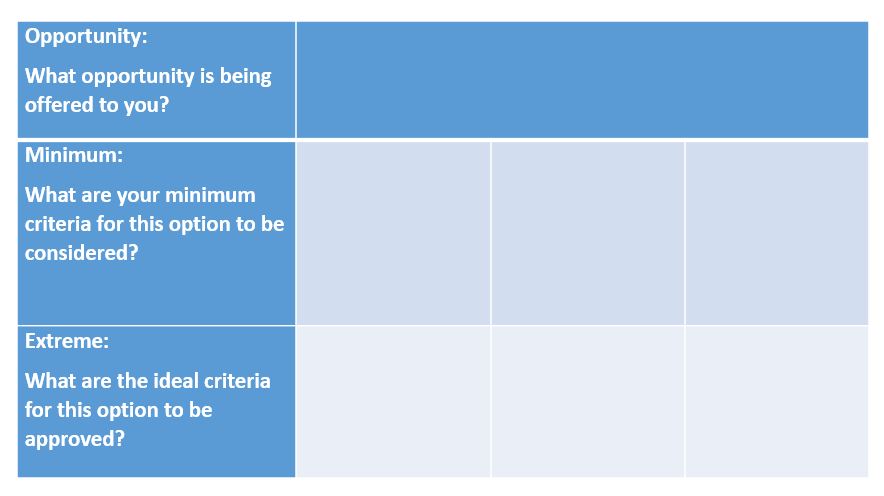
  3. If you want to get all ‘corporate’ and want to use a systematic process to help you through your dilemma of choices for all opportunities that come your way, then first write down the opportunity. Second, write down a list of three “minimum criteria” the options would need to “pass” to be considered. Third, write down a list of three ideal or “extreme criteria” the options would need to “pass” to be considered. By definition, if the opportunity doesn’t pass the first set of criteria, the answer is a ‘no-brainer’ no. But if it also doesn’t pass two of your three extreme criteria, the answer is still no.

    Essentialist's Opportunity Grid

    Essentialist’s grid to selecting opportunities

  4. There are three deeply entrenched assumptions you must conquer to live the way of the ‘Essentialist’:
    1. “I have to,”
    2. “It’s all important,” and
    3. “I can do both.”

Replace these false assumptions with three core truths:

  1. “I choose to,”
  2. “Only a few things really matter,” and
  3. “I can do anything but not everything.”

He says, “These simple truths awaken us from our non-essential stupor. They free us to pursue what really matters. They enable us to live at our highest level of contribution.”

  1. If you’re trying to find a unique positioning for your company then just ask the one essential question that will inform every future decision you will ever make: “If we could be truly excellent at only one thing, what would it be?”
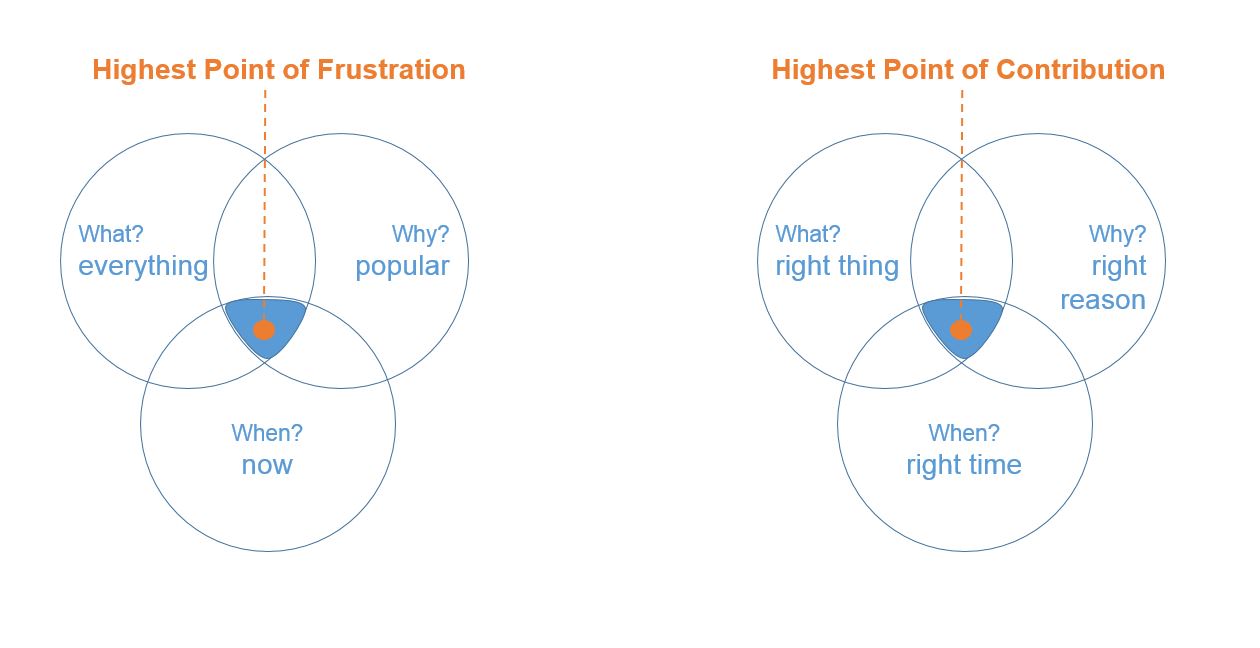
  2. Find your highest point of contribution and avoid your highest point of frustration like you would avoid a serial killer.
Essentialist highest point of contribution

Your Highest Point of Frustration & Contribution for a task

My 7 favorite random tips (from the book), to help live like a master rather than a slave

  1. When you’re cleaning your cupboard and can’t decide which of your favorite torn lingerie to dispose, instead of asking, “Is there a chance I will wear this someday in the future?” ask more disciplined, tough questions:
    1. “Do I love this?” and
    2. “Do I look great in it?” and
    3. “Do I wear this often?”

If the answer is no, then you know it is a candidate for elimination. You could also ask, “If I didn’t already own this, how much would I spend to buy it?”

  1. Likewise, in your life, the killer question when deciding what activities to eliminate is: “If I didn’t have this opportunity, what would I be willing to do to acquire it?
  2. A clear “no” can be more graceful than a vague or noncommittal “yes”. His point being, “Being vague is not the same as being graceful, and delaying the eventual “no” will only make it that much harder – and the recipient that much more resentful.”
  3. At work, if forced with an overload of tasks that will put your deadlines in disarray, ask your boss, colleague or client, “What should I deprioritize?”
  4. Add a 50 per cent buffer to the amount of time you estimate it will take to complete a task or project (if 50 per cent seems overly generous, consider how frequently things actually do take us 50 per cent longer than expected).
  5. The easiest and most effective way to change a habit or routine is not to try to stop it because that will mean having to change your behavior, which is hard. Instead, the trick is to find the cue that is triggering this non-essential behavior and find a way to associate that same cue with something that is essential. So for example if your alarm clock going off in the morning triggers you to check your e-mail, use it as a cue to get up and read instead. At first, overcoming the temptation to check the e-mail will be difficult. But each time you execute the new behaviour – each time you read the paper instead, it strengthens the link in your brain between the cue and the new behaviour, and soon, you’ll be subconsciously and automatically performing the new routine.
  6. Technology in this new age has abolished any chance of being bored. Technology has also obliterated all the time we used to have to think and process. He says, “The faster and busier things get, the more you need to build thinking time into your schedule. And the noisier things get, the more you need to build quiet reflection spaces in which you can truly focus.”

My 7 favorite ‘quool quotes’ (from the book)

  1. No is a complete sentence — Anne Lamott
  2. If you don’t prioritise your life, someone else will – Greg Mckeown (The Author)
  3. Strategy is about making choices, trade-offs. It’s about deliberately choosing to be different — Michael Porter
  4. Without great solitude no serious work is possible — Pablo Picasso
  5. Look see what really matters – Greg Mckeown (The Author)
  6. The main thing is to keep the main thing the main thing – Stephen R. Covey
  7. Beware the barrenness of a busy life — Socrates

We can take further inspiration from the example of CEO Bill Gates, who regularly (and famously) takes a regular week off from his daily duties at Microsoft simply to think and read. He calls it his “Think Week. And for those of you who are thinking that he’s got a stack of money higher than Mt. Everest with which he can do anything he wants to, you’re right. At the same time, think again if he really has it easier, cos I would imagine when one is in living the public eye, living up to ‘great expectations’ is probably more testing than living a life incognito.

The author says the essence is, “to apply the principle of condensing to our lives we need to shift the ratio of activity to meaning. We need to eliminate multiple meaningless activities and replace them with one very meaningful activity.”

And if you think all this ain’t really rad then just do as a pigeon does when in a quandary, close your eyes and ask, “What’s important now?” (Closing your eyes is the pigeon part, the asking is the benefits of being a human)

The secret to becoming interesting

Be Boring #MondayMorningWakeUpCall

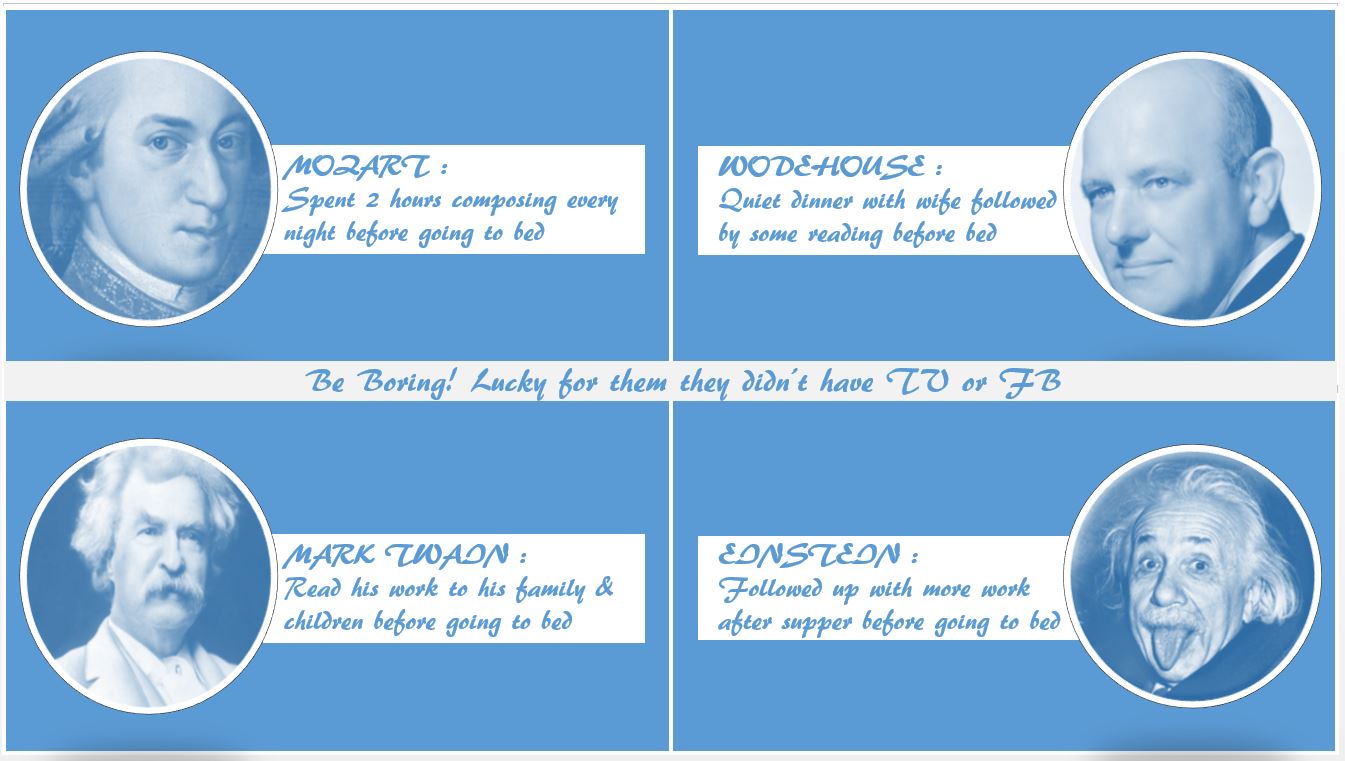
Daily routines of famous people

Be boring to be interesting

P.G. Wodehouse – Woke up at 7:30; performed calisthenics exercise, made & ate breakfast, read a ‘breakfast book’ and walked the dog, wrote from 9am to 2pm; followed by lunch and a walk; at 3:30 watch his favourite soap opera ‘Edge of Night’, had tea, snoozed and got in some more work till about 6pm; evening was cocktails and a quiet dinner with his wife, Ethel followed by some reading before bed. All this even at the ripe young age of 89.

Mozart – By 6am had his hair done and by 7am dressed and done with breakfast; he composed from 7am to 9am; 9am to 1pm he gave lessons; 1pm to 5pm was devoted to lunch and whiling away; 5pm to 9pm was spent either performing at a concert or composing; 9pm to 11pm was time spent with Constanze; he spent a couple of more hours composing before going to bed at 1am.

Albert Einstein (Life @ Princeton) – 9am to 10am had his breakfast and read the newspaper; he then walked to Princeton and worked there from 10:30am to 1:30pm; he returned home for lunch, took a nap, spent the rest of the afternoon balancing visitors, work and correspondence; he broke for supper at 6:30pm and followed it up with more work before retiring to bed.

Mark Twain – Post breakfast to 5pm in his study, sans lunch; evenings read his work to his family and children; Sundays was time spent with family and day dreaming.

Van Gogh – On most days he had a pretty straight forward life, 7am to 6pm paint with some food in between; post supper paint again till midnight.

Mason Curry in his book Daily Rituals, has written about the daily routines of 604 famous personalities, ranging from painters, writers, and musicians to philosophers and scientists, in an attempt to find out what they did differently that made them so incredibly good at their profession.

Some started work at dawn, while some worked best from dusk. Some were organized, while some thrived in chaos. Some worked round the clock, while some took long naps and strolls in between. Many had their own idiosyncrasies which probably gave them their super powers – Hemingway wrote standing, Proust wrote almost exclusively in bed, lying with his body almost completely horizontal and his head propped up by two pillows, Beethoven went for long vigorous walks to aid his creativity, Henri de Toulouse-Lautrec did his best work at night, sketching at cabarets or setting up his easel in brothels, the list goes on.

I found only one thing common between all these marvels that have etched their name in History. All of them seemed to be diligently disciplined about their daily work routines to the point of being as boring as a tame boar. Mason has put in a lot of research to prove that the outward lifestyles we see of the rock stars is but a myth. That creativity doesn’t come through bursts of inspiration.

There seems to be no other formula to excel other than find what work process and schedule works best for you and keep at it, day in and day out. Haruki Murakami seems to have the same belief saying “The repetition itself becomes the important thing; it’s a form of mesmerism. I mesmerize myself to reach a deeper state of mind.”

The irony is that by being boring, you become interesting, maybe even immortal.

Brothers in Arms

Oh what a day, what a lovely day, to start off with ‘Brothers in Arms’ I say #MondayMorningWakeUpCall

Mad Max: Fury Road blew my mind. The scenes along with the soundtrack is still playing in my head. At a surface level, it’s just a 2 hour relentless chase movie that doesn’t take its foot off the accelerator. The choreography, the energy and the visual spectacle of post apocalyptic dystopia is something that I haven’t seen or experienced before and am unlikely to for a while.

At a ‘reading in between the non-existent dialogues level’ it’s also about a couple of unlikely ‘Brothers in Arms’ fighting their way through ‘Fury Road’ and giving it a shot at redemption. It’s not much unlike life or even a startup, where it becomes easier, and dare I say, fun, to overcome obstacles and bury all ‘fury’, when done with ‘Brothers in Arms’.

Bonus: The music track of Brothers in Arms from the movie to start the day. It’s sure to drive away the Monday morning blues and get your energy levels revved up for the week.

https://www.youtube.com/watch?v=MgYnKu8RYAU