Category Archives: Geek Peek

4 practical titbits about reforming your habits

“Nothing so needs reforming as other people’s habits.” ― Mark Twain #MondayMorningWakeUpCall

 Power of Habits

If he reads why don’t you?

I guess Charles Duhigg took Mark Twain’s quote rather seriously (or was just fed up with his wife’s habits) and thankfully wrote “The Power of Habits” for others to reform. I in turn am happily sharing my ‘3 minute quickie’ for all those who don’t have the habit of reading but want to develop it. Or develop or renounce any other habit for that matter.

This post (and the book) is not limited only to reading habits. Duh! You can read and share this (After all, your habits aren’t a problem, are they? It’s other people’s habits that are a pain) with anyone whose habits make you squirm and whose habits you would want reformed, whether it be being a slave to a nicotine or caffeine, having to compulsively stand on one leg at midnight or severely lacking all the 7 habits of highly successful people.

Here are my notes along with 4 of my key learnings on habits including a framework that might help them quit those annoying behaviors and develop lovable ones.

But first, what are habits?

Habits as they are technically defined in the book are: “The choices that all of us deliberately make at some point, and then stop thinking about but continue doing, often every day. At one point, we all consciously decided how much to eat and what to focus on when we got to the office, how often to have a drink or when to go for a jog. Then we stopped making a choice, and the behavior became automatic. It’s a natural consequence of our neurology. And by understanding how it happens, you can rebuild those patterns in whichever way you choose.”

4 practical tit-bits about reforming your habits –

  1. Science of Habits – Habits are malleable
  • Habits, scientists say, emerge because the brain is constantly looking for ways to save effort.
  • Habits follow a loop – cue, routine, reward.
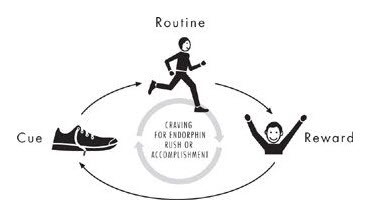
 

Cue Routine Reward Cycle

The Science Behind Habits

  • Society, as embodied by our courts and juries, has agreed that some habits are so powerful that they overwhelm our capacity to make choices, and thus we’re not responsible for what we do. Example gambling. (However this does not exempt you from the legal or moral repercussion. Once you know a habit exists, you have the responsibility to change it)
  1. Willpower is the single most important keystone habit for individual success.
  • Willpower is a learnable skill, something that can be taught the same way kids learn to do math and say “thank you.

(An aside outside of Charles Duhigg’s gyaan – I believe that the best way to learn and develop will power is through meditation practices. If practiced right then will power will no longer seem like having to ‘will’ yourself into habits or disciplines. Rather, they become a natural outcome, gracefully effortless rather than brute force)

  • Willpower isn’t just a skill. It’s a muscle, like the muscles in your arms or legs, and it gets tired as it works harder, so there’s less power left over for other things. Which is why if you’re spending up all your will power stopping yourself from punching your boss at work, it’s difficult to use the limited will power supply to control your diet or exercise at the end of the day.
  1. Tips to form a new habit
    • Focus on changing just one habit at first. Top of Form
    • Studies of people who have successfully started new exercise routines, for instance, show they are more likely to stick with a workout plan if they choose a specific cue, such as running as soon as they get home from work, and a clear reward, such as a beer or an evening of guilt-free television.
    • However a cue and a reward, on their own, aren’t enough for a new habit to last. Only when your brain starts expecting the reward—craving the endorphins or sense of accomplishment—will it become automatic to lace up your jogging shoes each morning. The cue, in addition to triggering a routine, must also trigger a craving for the reward to come.
    • But even that’s not enough. For a habit to stay changed, people must believe change is possible. And most often, that belief only emerges with the help of a group (which is why AA is so successful)
    • It is easier to convince someone to adopt a new behavior if there is something familiar at the beginning and end.
  2. Tips to changing a habit
    • Habits can be reshaped by simply understanding how habits work—learning the structure of the habit loop—makes them easier to control. Once you break a habit into its components, you can fiddle with the gears.

Here’s a 4 step framework for changing a habit

Disclaimer: In the book Charles Duhigg uses his example of how he changed his habit of eating a calorie inducing cookie every afternoon. I have tried to break down a more burning (pun intended) problem of smoking which has for more complex layers. However, it may be a more helpful application of the problem if you buy into the method/framework and not get into semantics of the example per se.

  • Step 1 – Identify the routine
    • The routine is the most obvious aspect. It’s the behavior you want to change. In this case lighting a cigarette and smoking it.
    • Next some less obvious questions –
      • What’s the cue for this routine? Is it post a meal? Boredom? Need a break before plunging into another task?
      • What’s the reward? Is it the after taste? Is it the high from nicotine? Socializing with colleagues? Temporary distraction?
    • To figure this out you’ll need to do a little experimentation
  • Step 2 – Experiment with rewards
    • Rewards are powerful because they satisfy cravings. But we’re often not conscious of the cravings that drive our behaviors. To figure out which cravings are driving particular habits, it’s useful to experiment with different rewards. This might take a few days or a week or even longer. During the period, you shouldn’t feel any pressure to make a real change- think of yourself as a scientist in the data collection stage.
    • On the 1st day of your experiment, when you feel the urge to smoke, adjust your routine so that it delivers a different reward. For instance, instead of taking a ‘smoke break’ go outside, walk around the block and then go back to the desk without smoking. The next day, try a cup of coffee. Then on another day you could walk over to a colleague and gossip for a few minutes and go back to your desk. Or pop in a nicotine flavored gum.
    • What you choose to do instead of smoking isn’t important. The point is to test different hypothesis to determine which craving is driving your routine.
    • As you test 4-5 different rewards, look for patterns and preferably jot down the 1st 3 things that come to mind immediately after your new routine.
    • Then set an alarm for 15 mins and ask yourself if you’re still feeling the urge for a smoke
    • By co-relating your experimental routines with the urge to smoke you should be able to identify the reward smoking is satisfying
  • Step 3 – Isolate the cue
    • Experiments have shown that almost all habitual cues fit into one of the 5 categories
      • Location (Where are you?)
      • Time (What time is it?)
      • Emotional state (What’s your emotional state?)
      • Other people (Who else is around?)
      • Immediately preceding action (What action preceded the urge?)
    • During this experimental phase, write down the answers to each of these 5 cues to identify common patterns
  • Step 4 – Have a plan
    • Once you’ve figured out your habit loop, you can change to a better routine (habit) by planning for the cue and choosing a behavior that delivers the reward you are craving. You can do so with a plan, ie. ‘when I see a CUE, I will do ROUTINE in order to get REWARD
    • For instance, in the smoking case, if you figured that your cue for a smoke is a meal and the reward is an after taste of nicotine, you could work towards a loop that looks like ‘when I finish my meal (CUE), I will chew a nicotine flavored gum (ROUTINE) in order to get the after taste of tobacco (REWARD)

It is important to note that though the process of habit change is easily described, it does not necessarily follow that it is easily accomplished. It is facile to imply that smoking, alcoholism, overeating, or other ingrained patterns can be upended without real effort. Genuine change requires work and self-understanding of the cravings driving behaviors. Changing any habit requires determination. No one will quit smoking cigarettes simply because they sketch a habit loop.

Most importantly – you’ve got to BELIEVE you can change!

What habits have you recently changed? How? Would love to hear your stories and comments.

Fight Song

Fight Song by Rachel Platten

“There’s still a lot of fight left in me”

#MondayMorningWakeUpCall I might have only one match but I can make an explosion – Fight Song by Rachel Platten

Find me a person who hasn’t had to fight through life before (and very often after) fame and fortune kissed her and I shall find you a magic lamp that exists outside our imagination.

Rachel Platten is on her way to fame and fortune’s exclusive party. She got invited only after she wrote a song to remind her that no matter how little her music got celebrated or how much she got punched, she believed in herself and she would continue to make music even if it was just for her ears only.

Rachel Platten released her first independent album in 2003 and since then has spent the last 12 years scrapping for gigs, grinding out small tours and trying to figure out how to make a dent in the music industry.

In an interview she mentioned “I wrote ‘Fight Song’ at a real low moment of feeling like, ‘Should I quit? Maybe I was wrong. Maybe I was deluding myself.’ There weren’t a lot of signs to keep going. But something in me — this tiny little crazy voice — would not let me quit. That song was the apex of that moment where it was like, ‘You are not quitting. If nobody else believes in you, you have to believe in yourself.'”

So if the song’s helped her get out of bed even on dark and depressing days with gusto, then I’m guessing, for a manic or no-manic Monday, what better #MondayMorningWakeUpCall could there be to punch through the week with a Fight Song playing in our head.

Hint: The trick however methinks is to not fight. More musings on this puzzling paradox another Monday morning. Till then, thank you Rachel Platten for your Fight Song.

Who you gonna call?

Who: The A Method for Hiring

Nope, not Ghostbusters if you’te looking for A-list employees

“It doesn’t matter what you know, it’s who you know.”

I wouldn’t go so far as saying it doesn’t matter what you know, but yes, I would tend to agree that in the professional world, sooner rather than later the ‘who’ does pop up.

Whether it be who you partner with, who are your investors, who your clients or suppliers are, your first few employees or 77th employee, who your colleagues are yada yada yada.

Hiring and retaining good talent is one of the toughest jobs in any company, even more so in early stage startups. In fact, hiring is such an important job that it’s usually one of the key responsibility areas of a CEO, especially since “who is where the magic begins, or where the problems starts” as Geoff Smart puts it so aptly in his book “Who: The A Method for Hiring” – a book where he shares what he claims to be a fail proof method to hiring A list candidates.

“What is an A Player? For one thing, he or she is not just a superstar. Think of an A Player as the right superstar, a talented person who can do the job you need done, while fitting in with the culture of your company. We define an A Player this way: a candidate who has at least a 90 percent chance of achieving a set of outcomes that only the top 10 percent of possible candidates could achieve”

His method is expectantly an extremely rigorous, some parts even questionable process to emulate. But if you can run the extra mile, you will be more likely to the find hidden treasure. Here is my 3 hour read cut short to 3 minutes for the benefit of the buzy and the lazy. (In my experience, both are usually the same person)

He outlines a 4 step method to his process –

  1. Scorecard: A Blueprint for Success
  2. Source: Generating a flow of A players
  3. Select: The 4 interviews for spotting A players
  4. Sell: The top 5 ways to seal the deal

Scorecard: A blueprint for success

A scorecard is the ghSMART (Geaff Smart’s company) version of a job description. The only difference is it is not a job description.

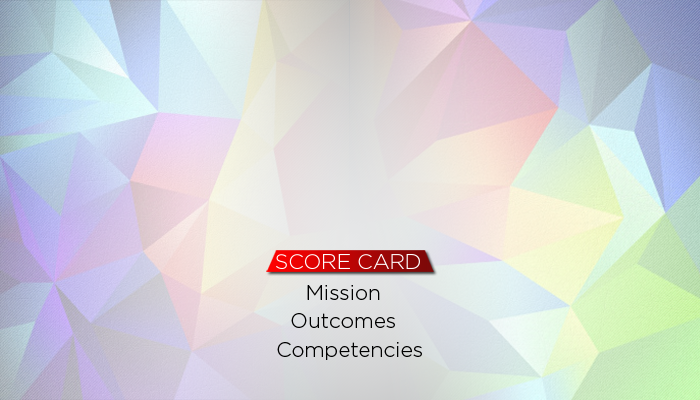
A scorecard has the following 3 elements –

The Scorecard for 'The A Method for Hiring'

The Scorecard for ‘The A Method for Hiring’

  1. Description of the mission for the position – an executive summary of the job’s core purpose. It boils the job down to its essence so everybody understands why you need to hire someone into the slot. Mission statements help you avoid one of the most common hiring traps: hiring all round athletes, i.e., generalists instead of specialists.
  2. Outcomes that must be accomplished – defining what must get done (it helps you to focus on evaluating a person on what she must get done, not her past accomplishments)
  3. Competencies that fit with both the culture of the company and the role – to ensure behavioral fit and organizational fit

Source: Generating a flow of A players

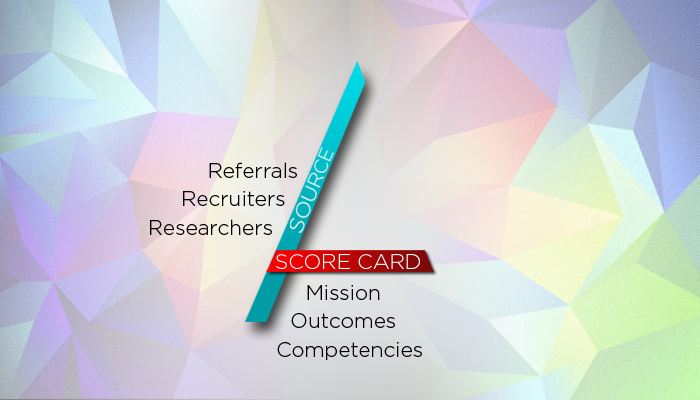
Smart quite rightly says, “Great candidates does not happen without significant effort.” His 3 key sourcing methodologies are –

Sourcing for 'The A Method for Hiring'

Sourcing for ‘The A Method for Hiring’

  1. Referrals – from professional network, personal network and employees. Smart cites this method as the number one method to source candidates from all the other methods even though this is the toughest and most time consuming.
  2. Recruiters – Hiring external recruiters
  3. Researchers – Hiring recruiting researchers who will explore the market, identify talent and feed names back to you. They won’t conduct the interviews.

Select: The 4 interviews for spotting A players

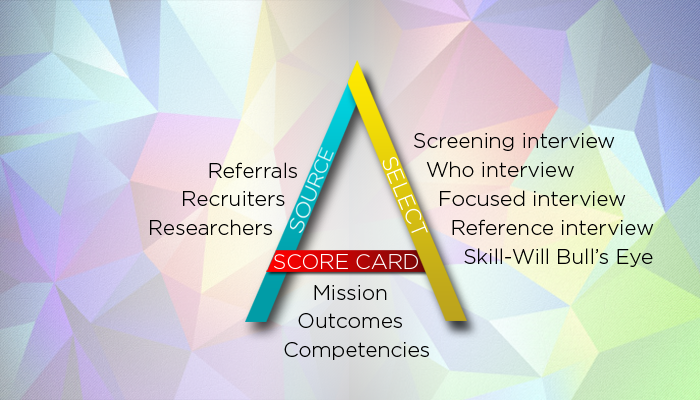
Geoff Smart says that the time span in most interviews that are currently conducted is too limited to reliably predict anything useful. Instead, he proposes a series of 4 interviews, each building on each other as the best and surest way of selecting A candidates. You can use the time through the 4 interviews to collect facts and data about someone’s performance track record that spans multiple years.

Selecting for 'The A Method for Hiring'

Selecting for ‘The A Method for Hiring’

The 4 interviews are –

  1. The screening interview – a short phone based interview designed to clear out B & C players from your roster of candidates. The questions (fixed) you ask are –
    • What are your career goals?
      1. If he or she lacks goals or sounds like an echo of your own Web site, screen the person out. You are done with the call. Talented people know what they want to do and are not afraid to tell you about it.
    • What are you really good at professionally?
      1. Geoff suggests you push candidates to tell you eight to twelve positives so you can build a complete picture of their professional aptitude. Ask them to give you examples that will put their strengths into context
    • What are you good at or not doing professionally?
      1. If you hear cookie-cutter answers, simply say, “That sounds like a strength to me. What are you really not good at or not interested in doing?” Talented people will catch the hint and reconsider their responses.
    • Who were your last ‘x’ bosses, and how will they each rate your performance on a 1–10 scale when we talk to them?
      1. You are looking for lots of 8’s, 9’s, and 10’s in the ratings.
  2. The Who interview – It is a chronological walk-through of a person’s career by asking the same set of 5 simple questions for each job, beginning with the earliest and working your way to the present day.

The Who interview is the key interview within the “Select” step of the ghSMART A Method for hiring. Geoff claims that this style of interviewing is the most valid and reliable predictor of performance according to a half-century’s work of thousands of research studies in the field of industrial psychology. It helps uncover data and patterns of behavior for making predictions about how somebody is likely to perform in the future. The questions 5 are –

  • What were you hired to do?
    1. The first question is a clear window into candidate’s goals and targets for a specific job. They might not know off the top of their heads so coach them by asking how they thought their success was measured in the role.
  • What accomplishments are you most proud of?
    1. A Players tend to talk about accomplishments that match the job outcomes they just described to you. B and C Players talk generally about events, people they met.
  • What were some low points during that job?
    1. Everybody has work lows. There isn’t a person alive who can claim otherwise so keep pushing by reframing the question over and over again till the candidate shares her answers with you
  • Who were the people you worked with? Specifically:
    1. What was your boss’ name, and how do you spell that? What was it like working with him/her? What will he/she tell me were your biggest strengths and areas for improvement?
    2. How would you rate the team you inherited on an A, B, C scale? What changes did you make? Did you hire anybody? How would you rate the team when you left it on an A, B, C scale?
  • Why did you leave that job?
    1. The final question of this vital Who Interview can be one of the most insight-producing questions you ask. Were they taking the next step in their career or running from something? How did their boss react to the news? Don’t accept vague answers. Get curious and dig deep for specifics.

3. The Focused Interview: Getting to know more – The focused interview is similar to the commonly used behavioral interview with one major difference: it is focused on the outcomes and competencies of the scorecard, not some vaguely defined job description or manager’s intuition. Focused interviews also give you the final gauge on the cultural fit with your organization.

  • The questions follow a simple structure just like the other interviews in the A Method quizzing on the candidate on –
    • What are your biggest accomplishments in this area during your career? (related to the specific outcomes of the scorecard)
    • What are your insights into your biggest mistakes and lessons learned in this area?
  • Assign 2-3 members of your team to perform focused interviews based on the scorecard and focus on separate outcomes.

4. The Reference Interview – To test and validate what you learned. Conduct the right number of reference interviews. The ghSMART A Method recommends that you personally do about four and ask your colleagues to do three, for a total of seven reference interviews. Interview three past bosses, two peers or customers, and two subordinate. Script your conversation with the following 5 questions –

  1. In what context did you work with the person?
    • The first question is really a conversation starter and memory jogger. Also in truth, Geoff believes, people don’t change that much. People aren’t mutual funds. Past performance really is an indicator of future performance.
  2. What were the person’s biggest strengths?
    • This questions is exactly the same as the screening interview ones.
  3. What were the person’s biggest areas of improvement back then?
    • In truth, Geoff believes, people don’t change that much. People aren’t mutual funds. Past performance really is an indicator of future performance.
  4. How would you rate his/her overall performance in that job on a 1-10 scale? What about his or her performance causes you to give that rating?
    • Once again you are looking for people who are consistently getting ratings of 8, 9, 10 across reference calls
  5. The person mentioned that he/she struggled with ______________ in that job. Can you tell me more about it?
    • This last question allows you to use the information from the TORC (threat of reference check) section of the Who interview

Red Flags

Based on experience, the major flags during the hiring process include:

  • Candidate does not mention past failures.
  • Candidate exaggerates his or her answers.
  • Candidate takes credit for the work of others.
  • Candidate speaks poorly of past bosses.
  • Candidate cannot explain job moves.
  • People most important to candidate are unsupportive of change.
  • For managerial hires, candidate has never had to hire or fire anybody.
  • Candidate seems more interested in compensation and benefits than in the job itself.
  • Candidate tries too hard to look like an expert.
  • Candidate is self-absorbed.

Sell: The top 5 ways to seal the deal

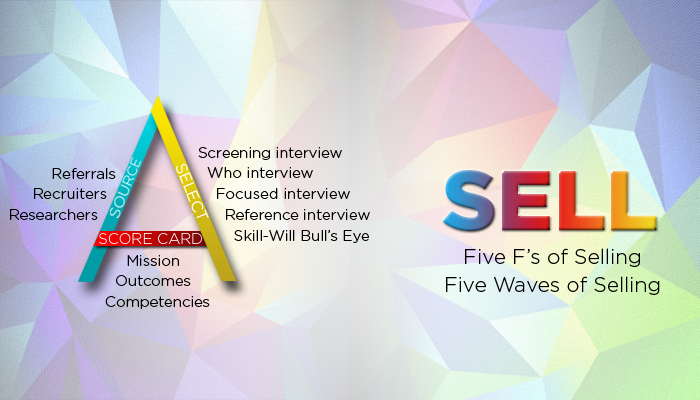
The key to successfully selling your candidate to join your company is putting yourself in his or her shoes. Care about what they care about. It turns out that candidates tend to care about five things, so make sure that you address each of these five areas until you get the person to sign on the dotted line.

Selling for 'The A Method for Hiring'

Selling for ‘The A Method for Hiring’

The five areas, which we call the five F’s of selling, are: fit, family, freedom, fortune, and fun.

  1. Fit – ties together the company’s vision, needs, and culture with the candidate’s goals, strengths, and values. “Here is where we are going as a company. Here is how you fit in.”
  2. Family – takes into account the broader trauma of changing jobs. “What can we do to make this change as easy as possible for your family?”
  3. Freedom – is the autonomy the candidate will have to make his or her own decisions. “I will give you ample freedom to make decisions, and I will not micromanage you.”
  4. Fortune – reflects the stability of your company and the overall financial upside. “If you accomplish your objectives, you will likely make [compensation amount] over the next five years.”
  5. Fun – describes the work environment and personal relationships the candidate will make. “We like to have a lot of fun around here. I think you will find this is a culture you will really enjoy.

If you thought this is way too much effort in hiring candidates then maybe the poll results from the leaders they interviewed for this study will make you think otherwise.

So, now that you’ve got ‘Who’ you know distilled down, the next question is “who knows you”. A different discussion for a different day.

Going from Zer0 to 0ne

The more we compete, the less we gain – Peter Thiel #MondayMorningWakeUpCall

Zero to One

Blue Apples – They not only keep the doctor away, you will also never have to brush a single day

Pop Quiz: What’s common between driving in traffic and driving a startup?

Answer: If you can pull yourself away from the crowd, your speed (and probability) of reaching the destination on time becomes (exponentially) higher. And what’s more, it comes sans the stress of a rat race.

The epiphany came to me when I was on my way to Pune last week, reading ‘Zer0 to 0ne’ by Peter Thiel (Paypal Co-founder) during the drive. In a particular section of the book Peter talks about the benefits of building a monopolistic company, which is, a company building so much value in its niche that it literally rules the market. This is in contrast to building a company in a crowded space amidst cut-throat competition by just re-packaging the same offerings, which is more likely to lead to everyone (or at least most) losing in the long run and sometimes even the short run.

Much like driving sans traffic vis-à-vis bumper traffic as I fathomed during my journey experience in my drive to Pune. For a change, I managed to leave well on time, at 7am, well ahead of the rush hour. I not only cut down my usual travel time by an hour (30%) by pulling myself away from the rush hour crowd, I also not once had stressed out during the journey to make time. Instead I soaked in the lush green scene en route and daydreamed about how to take Skillzot from 0 to 1.

To explain this simply, instead of fighting for apples from the same tree where half a dozen people are pulling each other’s hair and moustache to grab the most succulent apples, why not you plant an apple tree that gives blue apples, apples that will keep the doctor away, and, you can also promise your customer that she will never have to brush a single day.

Of course you could argue that making blue apples isn’t easy, maybe even impossible. But then again, is competing with blunt daggers any less difficult?

The idea here is that competing in a crowded market will at best lead to only incremental benefits. You can pull yourself exponentially ahead of a crowded market by creating new things that will make the future not just different, but better – to go from 0 to 1.

I got news for you!

Sun is shining and so are you #MondayMorningWakeUpCall

Axwell & Ingrosso, members of erstwhile Swedish House Mafia, seem to be making a habit of belting out galvanizing high energy EDM songs to stir us and spur us on to “Come out and play”. Right from their Swedish House Mafia days of ‘Don’t You Worry Child” to “Save The World” to the current ones in their new duo avatar – “Something New” and their latest “Sun Is Shining”, it seems to be more by design then by accident.

Whether it’s by design because they see world changing possibilities by way of individual change through music or because it makes for better business or a combination of both it, I’m not nit-picking. As long as it aligns itself with a greater cause of ‘waking up people on Monday mornings’ (or what the heck, any morning for that matter), I’m a fan.

Thank you Axwell & Ingrosso for your unwitting support to #MondayMorningWakeUpCall J

No is a complete sentence

No is a complete sentence #MondayMorningWakeUpCall

So says Anne Lamott. So agrees Greg McKeown. And he’s written 272 pages proving so in his book Essentialism: The Disciplined Pursuit of Less. I’d recommend this to you

  • If you think you are too busy but don’t feel the output is commiserate with the input,
  • Too busy doing things you don’t want to do and don’t have enough time to do what you would love to do
  • Or even if you are curious to find ways to identify what to focus on at work for your company, for the best bang for the buck.

I picked it up for the last reason and hope to try out some of his advice.

In the continued spirit of earning good karma sizzling brownie points though, I’m sharing my favorite pieces of advice which will help you ‘busy’ people become ‘Essentialists’ in 3 minutes instead of 3 hours.

If you haven’t guessed, an ‘Essentialist’ is one who does more by doing less. “She does so by applying a more selective criteria for what is essential, the pursuit of less allows her to gain control of her choices, so that she can make the highest possible contribution towards the things that really matter.”

 My 7 favorite tips to becoming an ‘Essentialist’ (from the book)

  1. Ask yourself, “If you could do only one thing with your life right now, what would you do?
    1. Or, conduct an advanced search and ask three questions:
      1. “What do I feel deeply inspired by?” and
      2. “What am I particularly talented at?” and
      3. “What meets a significant need in the world?
  1. Accept the reality of trade-offs. You can do anything you want to but you can’t do everything you want to (at least simultaneously).
  2. Ask the essential question: “What will I say no to?” when you face a dilemma of choices for opportunities that come your way, instead of asking yourself “What, of my list of competing priorities, should I say yes to?”
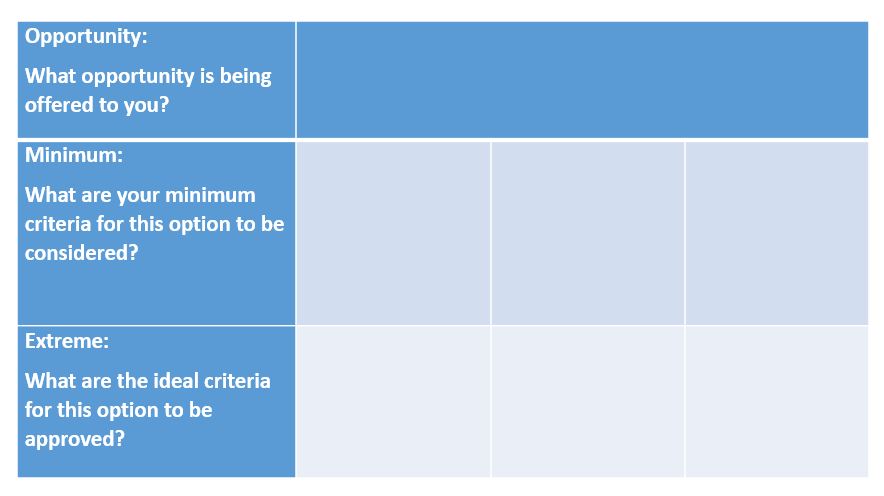
  3. If you want to get all ‘corporate’ and want to use a systematic process to help you through your dilemma of choices for all opportunities that come your way, then first write down the opportunity. Second, write down a list of three “minimum criteria” the options would need to “pass” to be considered. Third, write down a list of three ideal or “extreme criteria” the options would need to “pass” to be considered. By definition, if the opportunity doesn’t pass the first set of criteria, the answer is a ‘no-brainer’ no. But if it also doesn’t pass two of your three extreme criteria, the answer is still no.

    Essentialist's Opportunity Grid

    Essentialist’s grid to selecting opportunities

  4. There are three deeply entrenched assumptions you must conquer to live the way of the ‘Essentialist’:
    1. “I have to,”
    2. “It’s all important,” and
    3. “I can do both.”

Replace these false assumptions with three core truths:

  1. “I choose to,”
  2. “Only a few things really matter,” and
  3. “I can do anything but not everything.”

He says, “These simple truths awaken us from our non-essential stupor. They free us to pursue what really matters. They enable us to live at our highest level of contribution.”

  1. If you’re trying to find a unique positioning for your company then just ask the one essential question that will inform every future decision you will ever make: “If we could be truly excellent at only one thing, what would it be?”
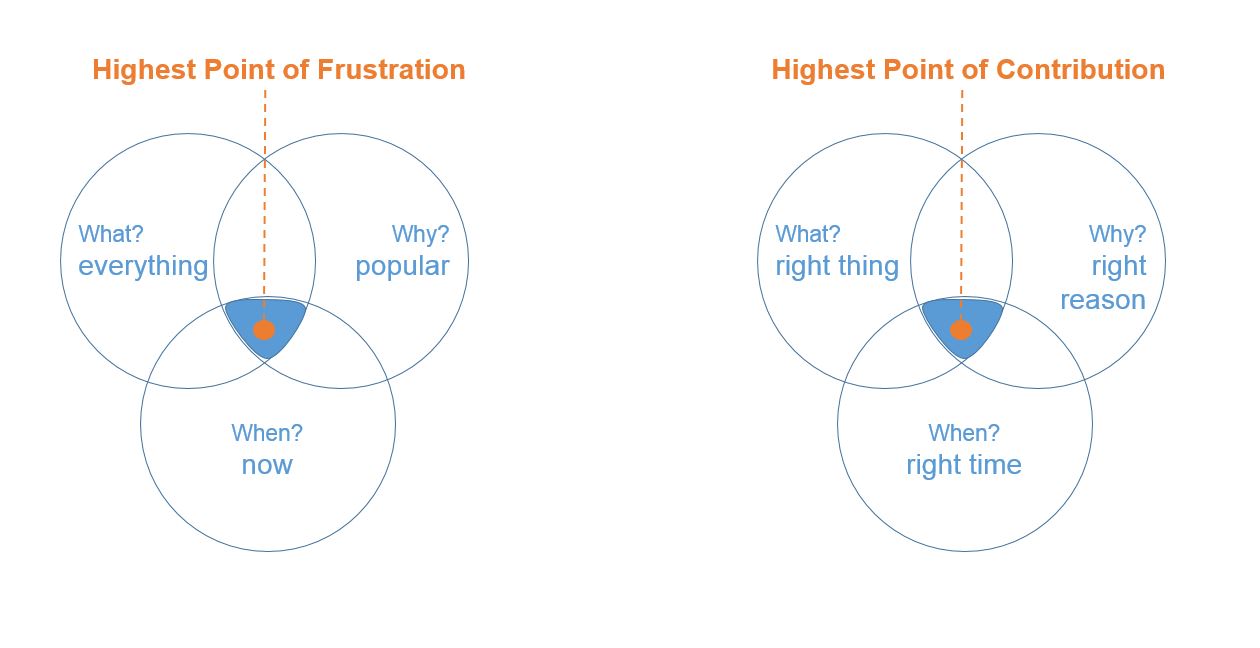
  2. Find your highest point of contribution and avoid your highest point of frustration like you would avoid a serial killer.
Essentialist highest point of contribution

Your Highest Point of Frustration & Contribution for a task

My 7 favorite random tips (from the book), to help live like a master rather than a slave

  1. When you’re cleaning your cupboard and can’t decide which of your favorite torn lingerie to dispose, instead of asking, “Is there a chance I will wear this someday in the future?” ask more disciplined, tough questions:
    1. “Do I love this?” and
    2. “Do I look great in it?” and
    3. “Do I wear this often?”

If the answer is no, then you know it is a candidate for elimination. You could also ask, “If I didn’t already own this, how much would I spend to buy it?”

  1. Likewise, in your life, the killer question when deciding what activities to eliminate is: “If I didn’t have this opportunity, what would I be willing to do to acquire it?
  2. A clear “no” can be more graceful than a vague or noncommittal “yes”. His point being, “Being vague is not the same as being graceful, and delaying the eventual “no” will only make it that much harder – and the recipient that much more resentful.”
  3. At work, if forced with an overload of tasks that will put your deadlines in disarray, ask your boss, colleague or client, “What should I deprioritize?”
  4. Add a 50 per cent buffer to the amount of time you estimate it will take to complete a task or project (if 50 per cent seems overly generous, consider how frequently things actually do take us 50 per cent longer than expected).
  5. The easiest and most effective way to change a habit or routine is not to try to stop it because that will mean having to change your behavior, which is hard. Instead, the trick is to find the cue that is triggering this non-essential behavior and find a way to associate that same cue with something that is essential. So for example if your alarm clock going off in the morning triggers you to check your e-mail, use it as a cue to get up and read instead. At first, overcoming the temptation to check the e-mail will be difficult. But each time you execute the new behaviour – each time you read the paper instead, it strengthens the link in your brain between the cue and the new behaviour, and soon, you’ll be subconsciously and automatically performing the new routine.
  6. Technology in this new age has abolished any chance of being bored. Technology has also obliterated all the time we used to have to think and process. He says, “The faster and busier things get, the more you need to build thinking time into your schedule. And the noisier things get, the more you need to build quiet reflection spaces in which you can truly focus.”

My 7 favorite ‘quool quotes’ (from the book)

  1. No is a complete sentence — Anne Lamott
  2. If you don’t prioritise your life, someone else will – Greg Mckeown (The Author)
  3. Strategy is about making choices, trade-offs. It’s about deliberately choosing to be different — Michael Porter
  4. Without great solitude no serious work is possible — Pablo Picasso
  5. Look see what really matters – Greg Mckeown (The Author)
  6. The main thing is to keep the main thing the main thing – Stephen R. Covey
  7. Beware the barrenness of a busy life — Socrates

We can take further inspiration from the example of CEO Bill Gates, who regularly (and famously) takes a regular week off from his daily duties at Microsoft simply to think and read. He calls it his “Think Week. And for those of you who are thinking that he’s got a stack of money higher than Mt. Everest with which he can do anything he wants to, you’re right. At the same time, think again if he really has it easier, cos I would imagine when one is in living the public eye, living up to ‘great expectations’ is probably more testing than living a life incognito.

The author says the essence is, “to apply the principle of condensing to our lives we need to shift the ratio of activity to meaning. We need to eliminate multiple meaningless activities and replace them with one very meaningful activity.”

And if you think all this ain’t really rad then just do as a pigeon does when in a quandary, close your eyes and ask, “What’s important now?” (Closing your eyes is the pigeon part, the asking is the benefits of being a human)

The secret to becoming interesting

Be Boring #MondayMorningWakeUpCall

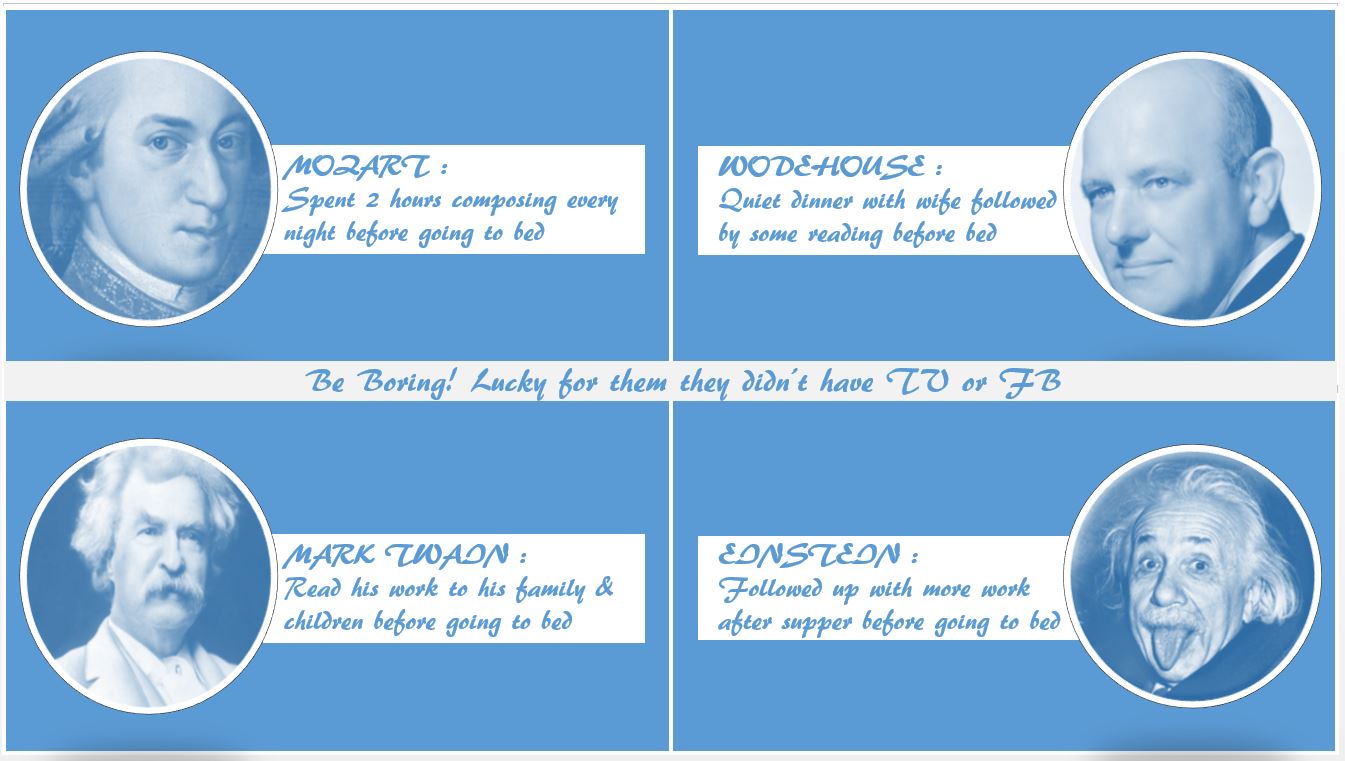
Daily routines of famous people

Be boring to be interesting

P.G. Wodehouse – Woke up at 7:30; performed calisthenics exercise, made & ate breakfast, read a ‘breakfast book’ and walked the dog, wrote from 9am to 2pm; followed by lunch and a walk; at 3:30 watch his favourite soap opera ‘Edge of Night’, had tea, snoozed and got in some more work till about 6pm; evening was cocktails and a quiet dinner with his wife, Ethel followed by some reading before bed. All this even at the ripe young age of 89.

Mozart – By 6am had his hair done and by 7am dressed and done with breakfast; he composed from 7am to 9am; 9am to 1pm he gave lessons; 1pm to 5pm was devoted to lunch and whiling away; 5pm to 9pm was spent either performing at a concert or composing; 9pm to 11pm was time spent with Constanze; he spent a couple of more hours composing before going to bed at 1am.

Albert Einstein (Life @ Princeton) – 9am to 10am had his breakfast and read the newspaper; he then walked to Princeton and worked there from 10:30am to 1:30pm; he returned home for lunch, took a nap, spent the rest of the afternoon balancing visitors, work and correspondence; he broke for supper at 6:30pm and followed it up with more work before retiring to bed.

Mark Twain – Post breakfast to 5pm in his study, sans lunch; evenings read his work to his family and children; Sundays was time spent with family and day dreaming.

Van Gogh – On most days he had a pretty straight forward life, 7am to 6pm paint with some food in between; post supper paint again till midnight.

Mason Curry in his book Daily Rituals, has written about the daily routines of 604 famous personalities, ranging from painters, writers, and musicians to philosophers and scientists, in an attempt to find out what they did differently that made them so incredibly good at their profession.

Some started work at dawn, while some worked best from dusk. Some were organized, while some thrived in chaos. Some worked round the clock, while some took long naps and strolls in between. Many had their own idiosyncrasies which probably gave them their super powers – Hemingway wrote standing, Proust wrote almost exclusively in bed, lying with his body almost completely horizontal and his head propped up by two pillows, Beethoven went for long vigorous walks to aid his creativity, Henri de Toulouse-Lautrec did his best work at night, sketching at cabarets or setting up his easel in brothels, the list goes on.

I found only one thing common between all these marvels that have etched their name in History. All of them seemed to be diligently disciplined about their daily work routines to the point of being as boring as a tame boar. Mason has put in a lot of research to prove that the outward lifestyles we see of the rock stars is but a myth. That creativity doesn’t come through bursts of inspiration.

There seems to be no other formula to excel other than find what work process and schedule works best for you and keep at it, day in and day out. Haruki Murakami seems to have the same belief saying “The repetition itself becomes the important thing; it’s a form of mesmerism. I mesmerize myself to reach a deeper state of mind.”

The irony is that by being boring, you become interesting, maybe even immortal.

Brothers in Arms

Oh what a day, what a lovely day, to start off with ‘Brothers in Arms’ I say #MondayMorningWakeUpCall

Mad Max: Fury Road blew my mind. The scenes along with the soundtrack is still playing in my head. At a surface level, it’s just a 2 hour relentless chase movie that doesn’t take its foot off the accelerator. The choreography, the energy and the visual spectacle of post apocalyptic dystopia is something that I haven’t seen or experienced before and am unlikely to for a while.

At a ‘reading in between the non-existent dialogues level’ it’s also about a couple of unlikely ‘Brothers in Arms’ fighting their way through ‘Fury Road’ and giving it a shot at redemption. It’s not much unlike life or even a startup, where it becomes easier, and dare I say, fun, to overcome obstacles and bury all ‘fury’, when done with ‘Brothers in Arms’.

Bonus: The music track of Brothers in Arms from the movie to start the day. It’s sure to drive away the Monday morning blues and get your energy levels revved up for the week.

A one sided love affair

A one sided love affair,
Is not a story many would share,
Cos we’ve created a world
Where we are embarrassed with anything short of gold.

But tell me o’ friend
Is it really the end,
When I am lucky to have felt the ecstasy of endless love,
Then to have felt the evanescent joy of a treasure trove.

However the question does remain,
How long do I live with the pain?
The answer that I hear whispered in my ear, 
Is just wait, soon the light I shall see, I need not fear.

The Universe will do what is best,
All I have to do is live in zest.