Category Archives: Book Look

4 practical titbits about reforming your habits

“Nothing so needs reforming as other people’s habits.” ― Mark Twain #MondayMorningWakeUpCall

 Power of Habits

If he reads why don’t you?

I guess Charles Duhigg took Mark Twain’s quote rather seriously (or was just fed up with his wife’s habits) and thankfully wrote “The Power of Habits” for others to reform. I in turn am happily sharing my ‘3 minute quickie’ for all those who don’t have the habit of reading but want to develop it. Or develop or renounce any other habit for that matter.

This post (and the book) is not limited only to reading habits. Duh! You can read and share this (After all, your habits aren’t a problem, are they? It’s other people’s habits that are a pain) with anyone whose habits make you squirm and whose habits you would want reformed, whether it be being a slave to a nicotine or caffeine, having to compulsively stand on one leg at midnight or severely lacking all the 7 habits of highly successful people.

Here are my notes along with 4 of my key learnings on habits including a framework that might help them quit those annoying behaviors and develop lovable ones.

But first, what are habits?

Habits as they are technically defined in the book are: “The choices that all of us deliberately make at some point, and then stop thinking about but continue doing, often every day. At one point, we all consciously decided how much to eat and what to focus on when we got to the office, how often to have a drink or when to go for a jog. Then we stopped making a choice, and the behavior became automatic. It’s a natural consequence of our neurology. And by understanding how it happens, you can rebuild those patterns in whichever way you choose.”

4 practical tit-bits about reforming your habits –

  1. Science of Habits – Habits are malleable
  • Habits, scientists say, emerge because the brain is constantly looking for ways to save effort.
  • Habits follow a loop – cue, routine, reward.
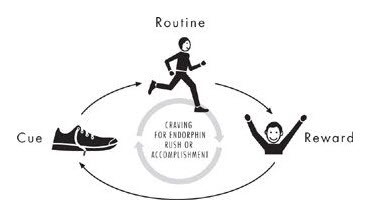
 

Cue Routine Reward Cycle

The Science Behind Habits

  • Society, as embodied by our courts and juries, has agreed that some habits are so powerful that they overwhelm our capacity to make choices, and thus we’re not responsible for what we do. Example gambling. (However this does not exempt you from the legal or moral repercussion. Once you know a habit exists, you have the responsibility to change it)
  1. Willpower is the single most important keystone habit for individual success.
  • Willpower is a learnable skill, something that can be taught the same way kids learn to do math and say “thank you.

(An aside outside of Charles Duhigg’s gyaan – I believe that the best way to learn and develop will power is through meditation practices. If practiced right then will power will no longer seem like having to ‘will’ yourself into habits or disciplines. Rather, they become a natural outcome, gracefully effortless rather than brute force)

  • Willpower isn’t just a skill. It’s a muscle, like the muscles in your arms or legs, and it gets tired as it works harder, so there’s less power left over for other things. Which is why if you’re spending up all your will power stopping yourself from punching your boss at work, it’s difficult to use the limited will power supply to control your diet or exercise at the end of the day.
  1. Tips to form a new habit
    • Focus on changing just one habit at first. Top of Form
    • Studies of people who have successfully started new exercise routines, for instance, show they are more likely to stick with a workout plan if they choose a specific cue, such as running as soon as they get home from work, and a clear reward, such as a beer or an evening of guilt-free television.
    • However a cue and a reward, on their own, aren’t enough for a new habit to last. Only when your brain starts expecting the reward—craving the endorphins or sense of accomplishment—will it become automatic to lace up your jogging shoes each morning. The cue, in addition to triggering a routine, must also trigger a craving for the reward to come.
    • But even that’s not enough. For a habit to stay changed, people must believe change is possible. And most often, that belief only emerges with the help of a group (which is why AA is so successful)
    • It is easier to convince someone to adopt a new behavior if there is something familiar at the beginning and end.
  2. Tips to changing a habit
    • Habits can be reshaped by simply understanding how habits work—learning the structure of the habit loop—makes them easier to control. Once you break a habit into its components, you can fiddle with the gears.

Here’s a 4 step framework for changing a habit

Disclaimer: In the book Charles Duhigg uses his example of how he changed his habit of eating a calorie inducing cookie every afternoon. I have tried to break down a more burning (pun intended) problem of smoking which has for more complex layers. However, it may be a more helpful application of the problem if you buy into the method/framework and not get into semantics of the example per se.

  • Step 1 – Identify the routine
    • The routine is the most obvious aspect. It’s the behavior you want to change. In this case lighting a cigarette and smoking it.
    • Next some less obvious questions –
      • What’s the cue for this routine? Is it post a meal? Boredom? Need a break before plunging into another task?
      • What’s the reward? Is it the after taste? Is it the high from nicotine? Socializing with colleagues? Temporary distraction?
    • To figure this out you’ll need to do a little experimentation
  • Step 2 – Experiment with rewards
    • Rewards are powerful because they satisfy cravings. But we’re often not conscious of the cravings that drive our behaviors. To figure out which cravings are driving particular habits, it’s useful to experiment with different rewards. This might take a few days or a week or even longer. During the period, you shouldn’t feel any pressure to make a real change- think of yourself as a scientist in the data collection stage.
    • On the 1st day of your experiment, when you feel the urge to smoke, adjust your routine so that it delivers a different reward. For instance, instead of taking a ‘smoke break’ go outside, walk around the block and then go back to the desk without smoking. The next day, try a cup of coffee. Then on another day you could walk over to a colleague and gossip for a few minutes and go back to your desk. Or pop in a nicotine flavored gum.
    • What you choose to do instead of smoking isn’t important. The point is to test different hypothesis to determine which craving is driving your routine.
    • As you test 4-5 different rewards, look for patterns and preferably jot down the 1st 3 things that come to mind immediately after your new routine.
    • Then set an alarm for 15 mins and ask yourself if you’re still feeling the urge for a smoke
    • By co-relating your experimental routines with the urge to smoke you should be able to identify the reward smoking is satisfying
  • Step 3 – Isolate the cue
    • Experiments have shown that almost all habitual cues fit into one of the 5 categories
      • Location (Where are you?)
      • Time (What time is it?)
      • Emotional state (What’s your emotional state?)
      • Other people (Who else is around?)
      • Immediately preceding action (What action preceded the urge?)
    • During this experimental phase, write down the answers to each of these 5 cues to identify common patterns
  • Step 4 – Have a plan
    • Once you’ve figured out your habit loop, you can change to a better routine (habit) by planning for the cue and choosing a behavior that delivers the reward you are craving. You can do so with a plan, ie. ‘when I see a CUE, I will do ROUTINE in order to get REWARD
    • For instance, in the smoking case, if you figured that your cue for a smoke is a meal and the reward is an after taste of nicotine, you could work towards a loop that looks like ‘when I finish my meal (CUE), I will chew a nicotine flavored gum (ROUTINE) in order to get the after taste of tobacco (REWARD)

It is important to note that though the process of habit change is easily described, it does not necessarily follow that it is easily accomplished. It is facile to imply that smoking, alcoholism, overeating, or other ingrained patterns can be upended without real effort. Genuine change requires work and self-understanding of the cravings driving behaviors. Changing any habit requires determination. No one will quit smoking cigarettes simply because they sketch a habit loop.

Most importantly – you’ve got to BELIEVE you can change!

What habits have you recently changed? How? Would love to hear your stories and comments.

Who you gonna call?

Who: The A Method for Hiring

Nope, not Ghostbusters if you’te looking for A-list employees

“It doesn’t matter what you know, it’s who you know.”

I wouldn’t go so far as saying it doesn’t matter what you know, but yes, I would tend to agree that in the professional world, sooner rather than later the ‘who’ does pop up.

Whether it be who you partner with, who are your investors, who your clients or suppliers are, your first few employees or 77th employee, who your colleagues are yada yada yada.

Hiring and retaining good talent is one of the toughest jobs in any company, even more so in early stage startups. In fact, hiring is such an important job that it’s usually one of the key responsibility areas of a CEO, especially since “who is where the magic begins, or where the problems starts” as Geoff Smart puts it so aptly in his book “Who: The A Method for Hiring” – a book where he shares what he claims to be a fail proof method to hiring A list candidates.

“What is an A Player? For one thing, he or she is not just a superstar. Think of an A Player as the right superstar, a talented person who can do the job you need done, while fitting in with the culture of your company. We define an A Player this way: a candidate who has at least a 90 percent chance of achieving a set of outcomes that only the top 10 percent of possible candidates could achieve”

His method is expectantly an extremely rigorous, some parts even questionable process to emulate. But if you can run the extra mile, you will be more likely to the find hidden treasure. Here is my 3 hour read cut short to 3 minutes for the benefit of the buzy and the lazy. (In my experience, both are usually the same person)

He outlines a 4 step method to his process –

  1. Scorecard: A Blueprint for Success
  2. Source: Generating a flow of A players
  3. Select: The 4 interviews for spotting A players
  4. Sell: The top 5 ways to seal the deal

Scorecard: A blueprint for success

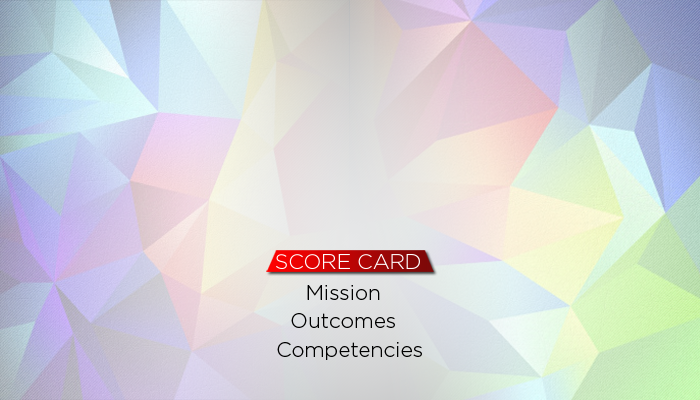
A scorecard is the ghSMART (Geaff Smart’s company) version of a job description. The only difference is it is not a job description.

A scorecard has the following 3 elements –

The Scorecard for 'The A Method for Hiring'

The Scorecard for ‘The A Method for Hiring’

  1. Description of the mission for the position – an executive summary of the job’s core purpose. It boils the job down to its essence so everybody understands why you need to hire someone into the slot. Mission statements help you avoid one of the most common hiring traps: hiring all round athletes, i.e., generalists instead of specialists.
  2. Outcomes that must be accomplished – defining what must get done (it helps you to focus on evaluating a person on what she must get done, not her past accomplishments)
  3. Competencies that fit with both the culture of the company and the role – to ensure behavioral fit and organizational fit

Source: Generating a flow of A players

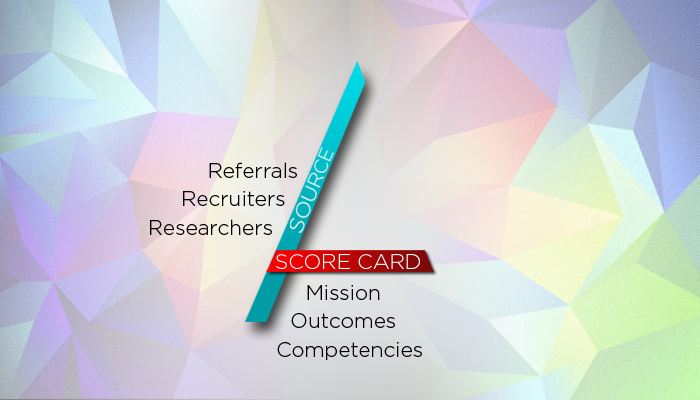
Smart quite rightly says, “Great candidates does not happen without significant effort.” His 3 key sourcing methodologies are –

Sourcing for 'The A Method for Hiring'

Sourcing for ‘The A Method for Hiring’

  1. Referrals – from professional network, personal network and employees. Smart cites this method as the number one method to source candidates from all the other methods even though this is the toughest and most time consuming.
  2. Recruiters – Hiring external recruiters
  3. Researchers – Hiring recruiting researchers who will explore the market, identify talent and feed names back to you. They won’t conduct the interviews.

Select: The 4 interviews for spotting A players

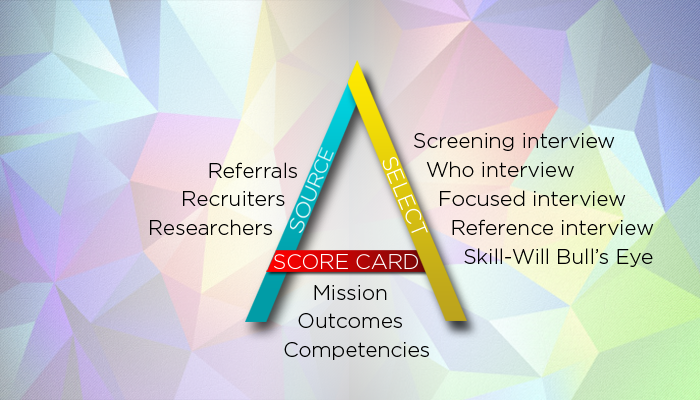
Geoff Smart says that the time span in most interviews that are currently conducted is too limited to reliably predict anything useful. Instead, he proposes a series of 4 interviews, each building on each other as the best and surest way of selecting A candidates. You can use the time through the 4 interviews to collect facts and data about someone’s performance track record that spans multiple years.

Selecting for 'The A Method for Hiring'

Selecting for ‘The A Method for Hiring’

The 4 interviews are –

  1. The screening interview – a short phone based interview designed to clear out B & C players from your roster of candidates. The questions (fixed) you ask are –
    • What are your career goals?
      1. If he or she lacks goals or sounds like an echo of your own Web site, screen the person out. You are done with the call. Talented people know what they want to do and are not afraid to tell you about it.
    • What are you really good at professionally?
      1. Geoff suggests you push candidates to tell you eight to twelve positives so you can build a complete picture of their professional aptitude. Ask them to give you examples that will put their strengths into context
    • What are you good at or not doing professionally?
      1. If you hear cookie-cutter answers, simply say, “That sounds like a strength to me. What are you really not good at or not interested in doing?” Talented people will catch the hint and reconsider their responses.
    • Who were your last ‘x’ bosses, and how will they each rate your performance on a 1–10 scale when we talk to them?
      1. You are looking for lots of 8’s, 9’s, and 10’s in the ratings.
  2. The Who interview – It is a chronological walk-through of a person’s career by asking the same set of 5 simple questions for each job, beginning with the earliest and working your way to the present day.

The Who interview is the key interview within the “Select” step of the ghSMART A Method for hiring. Geoff claims that this style of interviewing is the most valid and reliable predictor of performance according to a half-century’s work of thousands of research studies in the field of industrial psychology. It helps uncover data and patterns of behavior for making predictions about how somebody is likely to perform in the future. The questions 5 are –

  • What were you hired to do?
    1. The first question is a clear window into candidate’s goals and targets for a specific job. They might not know off the top of their heads so coach them by asking how they thought their success was measured in the role.
  • What accomplishments are you most proud of?
    1. A Players tend to talk about accomplishments that match the job outcomes they just described to you. B and C Players talk generally about events, people they met.
  • What were some low points during that job?
    1. Everybody has work lows. There isn’t a person alive who can claim otherwise so keep pushing by reframing the question over and over again till the candidate shares her answers with you
  • Who were the people you worked with? Specifically:
    1. What was your boss’ name, and how do you spell that? What was it like working with him/her? What will he/she tell me were your biggest strengths and areas for improvement?
    2. How would you rate the team you inherited on an A, B, C scale? What changes did you make? Did you hire anybody? How would you rate the team when you left it on an A, B, C scale?
  • Why did you leave that job?
    1. The final question of this vital Who Interview can be one of the most insight-producing questions you ask. Were they taking the next step in their career or running from something? How did their boss react to the news? Don’t accept vague answers. Get curious and dig deep for specifics.

3. The Focused Interview: Getting to know more – The focused interview is similar to the commonly used behavioral interview with one major difference: it is focused on the outcomes and competencies of the scorecard, not some vaguely defined job description or manager’s intuition. Focused interviews also give you the final gauge on the cultural fit with your organization.

  • The questions follow a simple structure just like the other interviews in the A Method quizzing on the candidate on –
    • What are your biggest accomplishments in this area during your career? (related to the specific outcomes of the scorecard)
    • What are your insights into your biggest mistakes and lessons learned in this area?
  • Assign 2-3 members of your team to perform focused interviews based on the scorecard and focus on separate outcomes.

4. The Reference Interview – To test and validate what you learned. Conduct the right number of reference interviews. The ghSMART A Method recommends that you personally do about four and ask your colleagues to do three, for a total of seven reference interviews. Interview three past bosses, two peers or customers, and two subordinate. Script your conversation with the following 5 questions –

  1. In what context did you work with the person?
    • The first question is really a conversation starter and memory jogger. Also in truth, Geoff believes, people don’t change that much. People aren’t mutual funds. Past performance really is an indicator of future performance.
  2. What were the person’s biggest strengths?
    • This questions is exactly the same as the screening interview ones.
  3. What were the person’s biggest areas of improvement back then?
    • In truth, Geoff believes, people don’t change that much. People aren’t mutual funds. Past performance really is an indicator of future performance.
  4. How would you rate his/her overall performance in that job on a 1-10 scale? What about his or her performance causes you to give that rating?
    • Once again you are looking for people who are consistently getting ratings of 8, 9, 10 across reference calls
  5. The person mentioned that he/she struggled with ______________ in that job. Can you tell me more about it?
    • This last question allows you to use the information from the TORC (threat of reference check) section of the Who interview

Red Flags

Based on experience, the major flags during the hiring process include:

  • Candidate does not mention past failures.
  • Candidate exaggerates his or her answers.
  • Candidate takes credit for the work of others.
  • Candidate speaks poorly of past bosses.
  • Candidate cannot explain job moves.
  • People most important to candidate are unsupportive of change.
  • For managerial hires, candidate has never had to hire or fire anybody.
  • Candidate seems more interested in compensation and benefits than in the job itself.
  • Candidate tries too hard to look like an expert.
  • Candidate is self-absorbed.

Sell: The top 5 ways to seal the deal

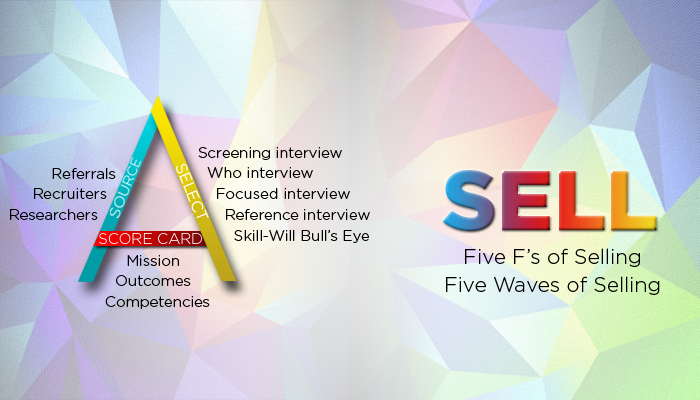
The key to successfully selling your candidate to join your company is putting yourself in his or her shoes. Care about what they care about. It turns out that candidates tend to care about five things, so make sure that you address each of these five areas until you get the person to sign on the dotted line.

Selling for 'The A Method for Hiring'

Selling for ‘The A Method for Hiring’

The five areas, which we call the five F’s of selling, are: fit, family, freedom, fortune, and fun.

  1. Fit – ties together the company’s vision, needs, and culture with the candidate’s goals, strengths, and values. “Here is where we are going as a company. Here is how you fit in.”
  2. Family – takes into account the broader trauma of changing jobs. “What can we do to make this change as easy as possible for your family?”
  3. Freedom – is the autonomy the candidate will have to make his or her own decisions. “I will give you ample freedom to make decisions, and I will not micromanage you.”
  4. Fortune – reflects the stability of your company and the overall financial upside. “If you accomplish your objectives, you will likely make [compensation amount] over the next five years.”
  5. Fun – describes the work environment and personal relationships the candidate will make. “We like to have a lot of fun around here. I think you will find this is a culture you will really enjoy.

If you thought this is way too much effort in hiring candidates then maybe the poll results from the leaders they interviewed for this study will make you think otherwise.

So, now that you’ve got ‘Who’ you know distilled down, the next question is “who knows you”. A different discussion for a different day.

Going from Zer0 to 0ne

The more we compete, the less we gain – Peter Thiel #MondayMorningWakeUpCall

Zero to One

Blue Apples – They not only keep the doctor away, you will also never have to brush a single day

Pop Quiz: What’s common between driving in traffic and driving a startup?

Answer: If you can pull yourself away from the crowd, your speed (and probability) of reaching the destination on time becomes (exponentially) higher. And what’s more, it comes sans the stress of a rat race.

The epiphany came to me when I was on my way to Pune last week, reading ‘Zer0 to 0ne’ by Peter Thiel (Paypal Co-founder) during the drive. In a particular section of the book Peter talks about the benefits of building a monopolistic company, which is, a company building so much value in its niche that it literally rules the market. This is in contrast to building a company in a crowded space amidst cut-throat competition by just re-packaging the same offerings, which is more likely to lead to everyone (or at least most) losing in the long run and sometimes even the short run.

Much like driving sans traffic vis-à-vis bumper traffic as I fathomed during my journey experience in my drive to Pune. For a change, I managed to leave well on time, at 7am, well ahead of the rush hour. I not only cut down my usual travel time by an hour (30%) by pulling myself away from the rush hour crowd, I also not once had stressed out during the journey to make time. Instead I soaked in the lush green scene en route and daydreamed about how to take Skillzot from 0 to 1.

To explain this simply, instead of fighting for apples from the same tree where half a dozen people are pulling each other’s hair and moustache to grab the most succulent apples, why not you plant an apple tree that gives blue apples, apples that will keep the doctor away, and, you can also promise your customer that she will never have to brush a single day.

Of course you could argue that making blue apples isn’t easy, maybe even impossible. But then again, is competing with blunt daggers any less difficult?

The idea here is that competing in a crowded market will at best lead to only incremental benefits. You can pull yourself exponentially ahead of a crowded market by creating new things that will make the future not just different, but better – to go from 0 to 1.

No is a complete sentence

No is a complete sentence #MondayMorningWakeUpCall

So says Anne Lamott. So agrees Greg McKeown. And he’s written 272 pages proving so in his book Essentialism: The Disciplined Pursuit of Less. I’d recommend this to you

  • If you think you are too busy but don’t feel the output is commiserate with the input,
  • Too busy doing things you don’t want to do and don’t have enough time to do what you would love to do
  • Or even if you are curious to find ways to identify what to focus on at work for your company, for the best bang for the buck.

I picked it up for the last reason and hope to try out some of his advice.

In the continued spirit of earning good karma sizzling brownie points though, I’m sharing my favorite pieces of advice which will help you ‘busy’ people become ‘Essentialists’ in 3 minutes instead of 3 hours.

If you haven’t guessed, an ‘Essentialist’ is one who does more by doing less. “She does so by applying a more selective criteria for what is essential, the pursuit of less allows her to gain control of her choices, so that she can make the highest possible contribution towards the things that really matter.”

 My 7 favorite tips to becoming an ‘Essentialist’ (from the book)

  1. Ask yourself, “If you could do only one thing with your life right now, what would you do?
    1. Or, conduct an advanced search and ask three questions:
      1. “What do I feel deeply inspired by?” and
      2. “What am I particularly talented at?” and
      3. “What meets a significant need in the world?
  1. Accept the reality of trade-offs. You can do anything you want to but you can’t do everything you want to (at least simultaneously).
  2. Ask the essential question: “What will I say no to?” when you face a dilemma of choices for opportunities that come your way, instead of asking yourself “What, of my list of competing priorities, should I say yes to?”
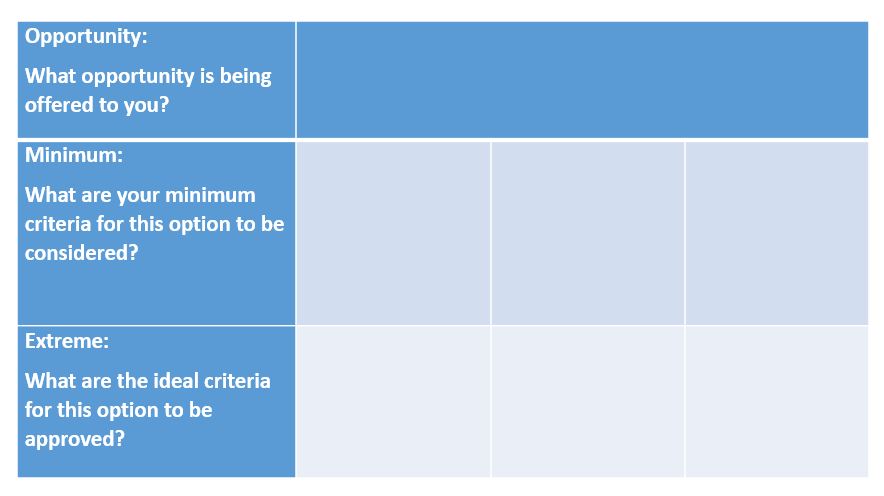
  3. If you want to get all ‘corporate’ and want to use a systematic process to help you through your dilemma of choices for all opportunities that come your way, then first write down the opportunity. Second, write down a list of three “minimum criteria” the options would need to “pass” to be considered. Third, write down a list of three ideal or “extreme criteria” the options would need to “pass” to be considered. By definition, if the opportunity doesn’t pass the first set of criteria, the answer is a ‘no-brainer’ no. But if it also doesn’t pass two of your three extreme criteria, the answer is still no.

    Essentialist's Opportunity Grid

    Essentialist’s grid to selecting opportunities

  4. There are three deeply entrenched assumptions you must conquer to live the way of the ‘Essentialist’:
    1. “I have to,”
    2. “It’s all important,” and
    3. “I can do both.”

Replace these false assumptions with three core truths:

  1. “I choose to,”
  2. “Only a few things really matter,” and
  3. “I can do anything but not everything.”

He says, “These simple truths awaken us from our non-essential stupor. They free us to pursue what really matters. They enable us to live at our highest level of contribution.”

  1. If you’re trying to find a unique positioning for your company then just ask the one essential question that will inform every future decision you will ever make: “If we could be truly excellent at only one thing, what would it be?”
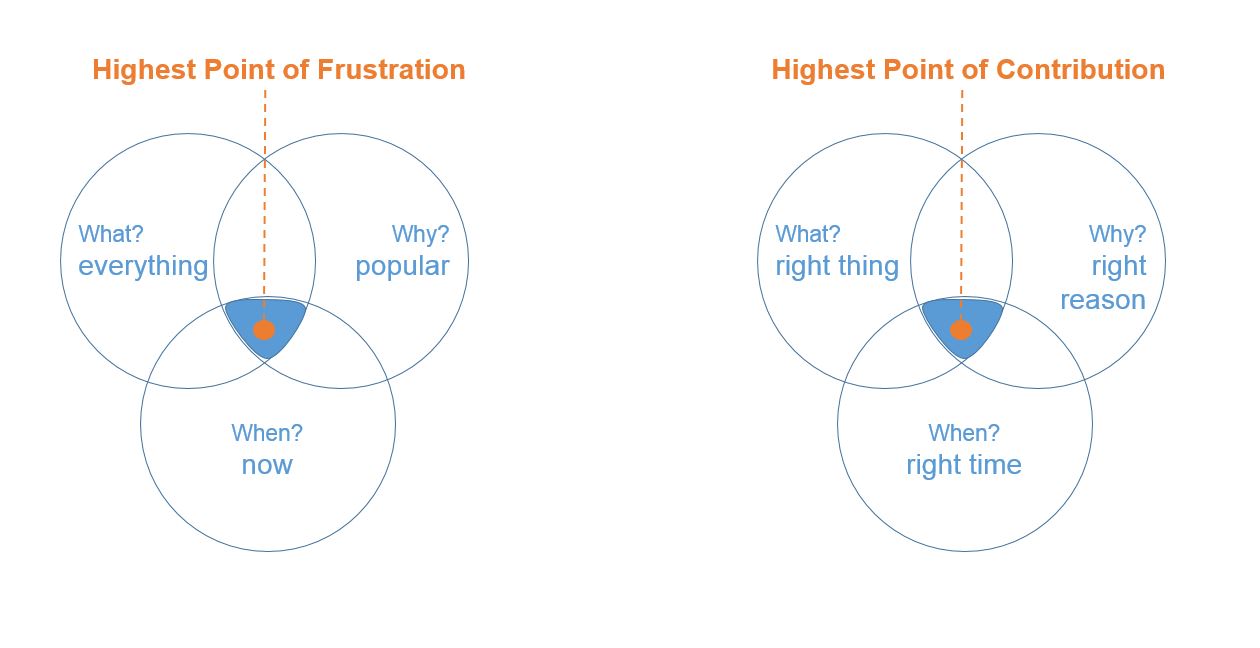
  2. Find your highest point of contribution and avoid your highest point of frustration like you would avoid a serial killer.
Essentialist highest point of contribution

Your Highest Point of Frustration & Contribution for a task

My 7 favorite random tips (from the book), to help live like a master rather than a slave

  1. When you’re cleaning your cupboard and can’t decide which of your favorite torn lingerie to dispose, instead of asking, “Is there a chance I will wear this someday in the future?” ask more disciplined, tough questions:
    1. “Do I love this?” and
    2. “Do I look great in it?” and
    3. “Do I wear this often?”

If the answer is no, then you know it is a candidate for elimination. You could also ask, “If I didn’t already own this, how much would I spend to buy it?”

  1. Likewise, in your life, the killer question when deciding what activities to eliminate is: “If I didn’t have this opportunity, what would I be willing to do to acquire it?
  2. A clear “no” can be more graceful than a vague or noncommittal “yes”. His point being, “Being vague is not the same as being graceful, and delaying the eventual “no” will only make it that much harder – and the recipient that much more resentful.”
  3. At work, if forced with an overload of tasks that will put your deadlines in disarray, ask your boss, colleague or client, “What should I deprioritize?”
  4. Add a 50 per cent buffer to the amount of time you estimate it will take to complete a task or project (if 50 per cent seems overly generous, consider how frequently things actually do take us 50 per cent longer than expected).
  5. The easiest and most effective way to change a habit or routine is not to try to stop it because that will mean having to change your behavior, which is hard. Instead, the trick is to find the cue that is triggering this non-essential behavior and find a way to associate that same cue with something that is essential. So for example if your alarm clock going off in the morning triggers you to check your e-mail, use it as a cue to get up and read instead. At first, overcoming the temptation to check the e-mail will be difficult. But each time you execute the new behaviour – each time you read the paper instead, it strengthens the link in your brain between the cue and the new behaviour, and soon, you’ll be subconsciously and automatically performing the new routine.
  6. Technology in this new age has abolished any chance of being bored. Technology has also obliterated all the time we used to have to think and process. He says, “The faster and busier things get, the more you need to build thinking time into your schedule. And the noisier things get, the more you need to build quiet reflection spaces in which you can truly focus.”

My 7 favorite ‘quool quotes’ (from the book)

  1. No is a complete sentence — Anne Lamott
  2. If you don’t prioritise your life, someone else will – Greg Mckeown (The Author)
  3. Strategy is about making choices, trade-offs. It’s about deliberately choosing to be different — Michael Porter
  4. Without great solitude no serious work is possible — Pablo Picasso
  5. Look see what really matters – Greg Mckeown (The Author)
  6. The main thing is to keep the main thing the main thing – Stephen R. Covey
  7. Beware the barrenness of a busy life — Socrates

We can take further inspiration from the example of CEO Bill Gates, who regularly (and famously) takes a regular week off from his daily duties at Microsoft simply to think and read. He calls it his “Think Week. And for those of you who are thinking that he’s got a stack of money higher than Mt. Everest with which he can do anything he wants to, you’re right. At the same time, think again if he really has it easier, cos I would imagine when one is in living the public eye, living up to ‘great expectations’ is probably more testing than living a life incognito.

The author says the essence is, “to apply the principle of condensing to our lives we need to shift the ratio of activity to meaning. We need to eliminate multiple meaningless activities and replace them with one very meaningful activity.”

And if you think all this ain’t really rad then just do as a pigeon does when in a quandary, close your eyes and ask, “What’s important now?” (Closing your eyes is the pigeon part, the asking is the benefits of being a human)

The secret to becoming interesting

Be Boring #MondayMorningWakeUpCall

Daily routines of famous people

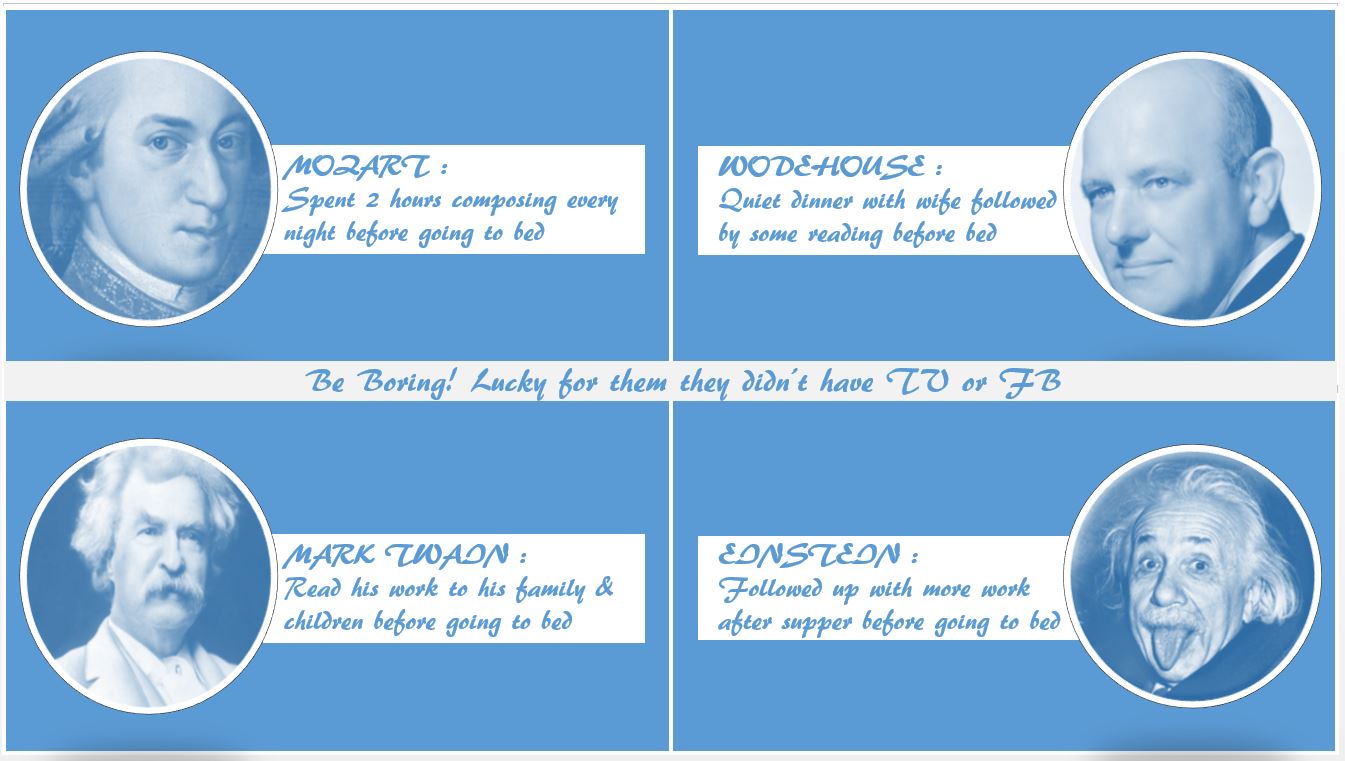
Be boring to be interesting

P.G. Wodehouse – Woke up at 7:30; performed calisthenics exercise, made & ate breakfast, read a ‘breakfast book’ and walked the dog, wrote from 9am to 2pm; followed by lunch and a walk; at 3:30 watch his favourite soap opera ‘Edge of Night’, had tea, snoozed and got in some more work till about 6pm; evening was cocktails and a quiet dinner with his wife, Ethel followed by some reading before bed. All this even at the ripe young age of 89.

Mozart – By 6am had his hair done and by 7am dressed and done with breakfast; he composed from 7am to 9am; 9am to 1pm he gave lessons; 1pm to 5pm was devoted to lunch and whiling away; 5pm to 9pm was spent either performing at a concert or composing; 9pm to 11pm was time spent with Constanze; he spent a couple of more hours composing before going to bed at 1am.

Albert Einstein (Life @ Princeton) – 9am to 10am had his breakfast and read the newspaper; he then walked to Princeton and worked there from 10:30am to 1:30pm; he returned home for lunch, took a nap, spent the rest of the afternoon balancing visitors, work and correspondence; he broke for supper at 6:30pm and followed it up with more work before retiring to bed.

Mark Twain – Post breakfast to 5pm in his study, sans lunch; evenings read his work to his family and children; Sundays was time spent with family and day dreaming.

Van Gogh – On most days he had a pretty straight forward life, 7am to 6pm paint with some food in between; post supper paint again till midnight.

Mason Curry in his book Daily Rituals, has written about the daily routines of 604 famous personalities, ranging from painters, writers, and musicians to philosophers and scientists, in an attempt to find out what they did differently that made them so incredibly good at their profession.

Some started work at dawn, while some worked best from dusk. Some were organized, while some thrived in chaos. Some worked round the clock, while some took long naps and strolls in between. Many had their own idiosyncrasies which probably gave them their super powers – Hemingway wrote standing, Proust wrote almost exclusively in bed, lying with his body almost completely horizontal and his head propped up by two pillows, Beethoven went for long vigorous walks to aid his creativity, Henri de Toulouse-Lautrec did his best work at night, sketching at cabarets or setting up his easel in brothels, the list goes on.

I found only one thing common between all these marvels that have etched their name in History. All of them seemed to be diligently disciplined about their daily work routines to the point of being as boring as a tame boar. Mason has put in a lot of research to prove that the outward lifestyles we see of the rock stars is but a myth. That creativity doesn’t come through bursts of inspiration.

There seems to be no other formula to excel other than find what work process and schedule works best for you and keep at it, day in and day out. Haruki Murakami seems to have the same belief saying “The repetition itself becomes the important thing; it’s a form of mesmerism. I mesmerize myself to reach a deeper state of mind.”

The irony is that by being boring, you become interesting, maybe even immortal.

So you think you can write!

“The two kinds of people are those who think they can write, and those who think they can’t. (And too often both are wrong!) – Ann Handley

Even if we aren’t professional writers, most of our professions require us to write, every day. We write to communicate, to persuade, and with the advent of the internet, simply share. Yet we pay little or no attention to improving our writing skills. Most likely because we think we can write well enough for the person at the other end to understand what we are saying and we can get by our jobs (mostly the ones which are not linked to professional writing) without any real need to improve.

Maybe that’s true. Maybe that’s not.

For reasons beyond my comprehension, I decided to blog from this year (2015). So I figured, if by the off chance, people stumble upon my ramblings, then I owe it to the unfortunate reader to allay the horrors that may come his/her way. With that in mind I recently devoured a highly recommended book by Amazon – Everybody Writes: Your Go-To Guide To Creating Ridiculously Good Content by Ann Handley.

I recommend it too (not highly) if you are looking to improve your writing, for professional purposes or otherwise. She covers 75 very very practical tips that cover how to write better, grammar and usage, telling a story, publishing, social media writing tips and content tools that you can use.

But then I know that you are too busy, which in my parlance is lazy, to read 282 pages of what you think you already are a master at. So in my attempt to earn ‘good karma’ brownie points, I’m sharing my top take away and learnings, (which I shall also try to apply bit by bit), for the good souls who want to improve but are too lazy, er busy to learn. After all, she argues that “writing is a habit, not an art.”

  1. Quality content means content that is packed with clear utility and is brimming with inspiration, and it has relentless empathy for the audience. “Start with empathy. Continue with utility. Improve with analysis. Optimize with love.”
  2. Follow a writing GPS – Good writing takes planning and preparation; it doesn’t just emerge, fully formed, out of the head of Zeus. Or your own head, for that matter.
  3. Organize – Good writing is like math: it has logic and structure. (There’s no single way to organize a piece of writing though)
  4. Swap Places with Your Reader – Good writing serves the reader, not the writer. It isn’t self-indulgent. Good writing anticipates the questions that readers might have as they’re reading a piece, and it answers them.
  5. Develop pathological empathy – Use a customer/audience-centric POV. Replace ‘I’ or ‘we’ with ‘you’ to shift the focus to the audience/customer’s point of view.
  6. Put some extra thought to writing a good lede (Opening). Some ideas are –
    1. Put your reader or someone just like your reader into the story.
    2. Describe a problem your reader can relate to.
    3. Set a stage.
    4. Ask a question.
    5. Quote a crazy or controversial bit of data.
    6. Tell a story or relay a personal anecdote.
    7. Other options – Start with a quote. Use an analogy. Make a bold statement.
  7. Place the most important words (and ideas) at the beginning of each sentence. Hence, phrases to avoid at the start of a sentences – (You can tack them onto the end, or insert them somewhere in the middle—if you must use them at all.)
    1. According to…
    2. There is a…
    3. It is [important, critical, advised, suggested, and so on]…
    4. In my opinion…
    5. The purpose of this [email, post, article] is…
    6. In 2014 [or any year]…
    7. I think [believe] that
  8. Ditch Weakling Verbs – Instead of: In his anger, he accidentally cut his finger. Try: In his anger, he accidentally slashed his finger.
  9. Limit moralizing or preaching. So avoid phrases or words like –
    1. Don’t forget…
    2. Never…
    3. Avoid…
    4. Don’t…
    5. Remember to…
    6. Always remember to…
  10. Break some grammar rules (these 5)
    1. Never start a sentence with and, but, or because.
    2. Avoid sentence fragments. It’s perfectly fine to sparingly add sentence fragments for emphasis. At least, sometimes. (Like that.) (And that too.) (And this.)
    3. Never split infinitives.
    4. Don’t end a sentence with a preposition.
      1. One big unless: “You shouldn’t end a sentence with a preposition when the sentence would mean the same thing if you left off the preposition,” Grammar Girl notes. “That means ‘Where are you at?’ is wrong because ‘Where are you?’ means the same thing.
    5. Never write a paragraph that’s a mere one sentence long.

If you’re still curious for more… social media writing advice, tips like ideal length of FB posts, Tweets, Blog lengths, writing headlines or landing pages or even a repository of content tools to simplify your writing process, you’ll have to take that little bit of extra effort to go through the 282 pages of Everybody Writes: Your Go-To Guide To Creating Ridiculously Good Content by Ann Handley.

The meaning of ‘meaning of life’

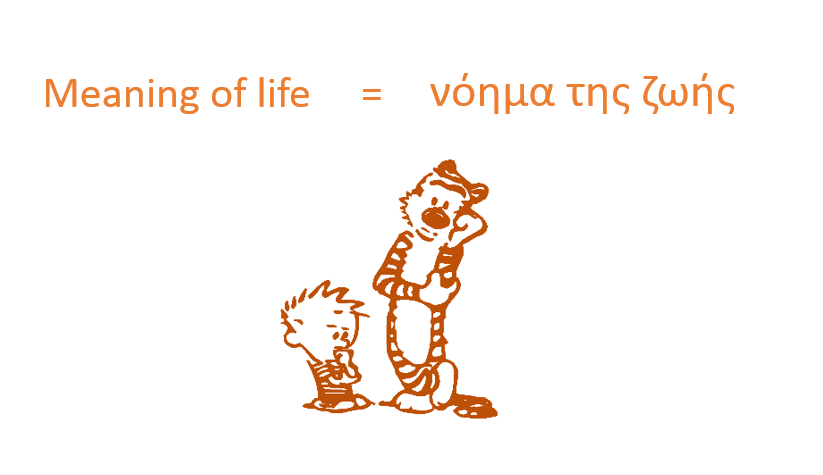
Meaning of Life

“Ya, it’s Greek to me!”

“People have enough to live by but nothing to live for. They have means but no meaning” – Viktor E. Frankl posits in his book ‘Man’s Search for Meaning’. In the book, he narrates his life as an inmate in the Aushwitz Concentration Camp during World War II and his theories on what made some people endure the atrocities and come out alive while so many others just gave up.

He says “Those who have a ‘why’ to live, can bear with almost any ‘how’.” However this ‘why’ is not always an easy answer. This ‘why’ has been a source of existential angst from Siddhartha Gautama to Calvin, not necessarily leading to enlightenment or even peace of mind for most people.

This ‘why’ could be for reasons as varied as love or revenge, accumulating wealth and power or changing the world for the better, fame or family, unabashed hedonism or spiritual enlightenment.

As varied as the reasons could be, we still find people from 7 to 70 wondering what their purpose in life really is. Some even make it their purpose to find their purpose.

But I think obsessing over it isn’t as helpful as obsessing over ‘to be or not to be’ or which lingerie to wear on your date. The attitude that’s helped me not go insane while trying to figure ‘why the fc*!’ am I here’ is to keep looking for the answers but not seeking them, questioning even the most mundane but not getting hung up on finding the answer.

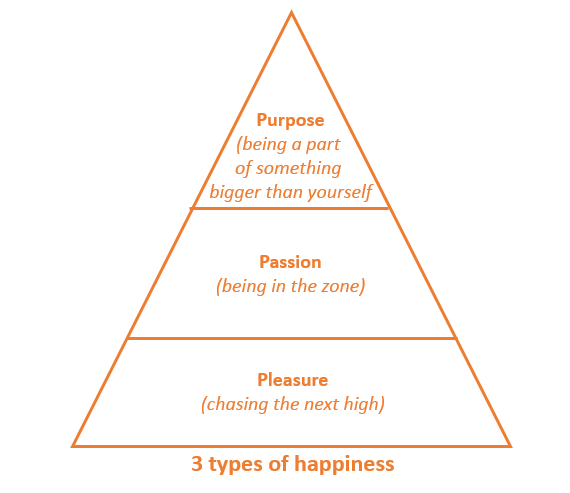
Doing this with an open mind has led me to intuitively traverse Tony Hsieh’s (CEO of www.zappos.com) 3P’s Pyramid which he spells out in his book Delivering Happiness (A book I’d highly recommend for entrepreneurs and all humans too).

According to Tony Hsieh, there are 3 types of happiness or the 3P’s Happiness Pyramid (Fig. 3.pee)


Tony Hsieh's Happiness Framework, 3P's of happiness

Fig. 3.pee

If there’s one thing in common between all the 6 billion homo sapiens in the world, it’s probably that we all have a common purpose of looking for ways to be happy. Unfortunately (or fortunately) I’m no different.

My happiness chasing started at the bottom P for ‘Pleasure’, ‘Pleasure’ being synonymous with girlfriends and money, thinking hedonism is the ‘soul’ purpose of my existence. Soon realization dawned that hedonistic pleasures were all short lived. Like Tony says. “The moment the stimuli goes away, the happiness levels drop immediately. In other words, this type of happiness is the shortest lasting.”

I sensed this even more so in my first corporate role. I was blessed to be working with a company many in my B-school batch would’ve happily traded their porn collection for. I was also blessed with a couple of clients who sucked blood for a living in my first year itself. While I was busy trying to stop the blood sucking, the pleasures were somewhere getting sucked out of my life.

Added to that, I realized that there was no way I could survive more than a leap year reading Gartner and IDC reports (“I barely managed to not flunk my Engineering Exams and now you want me to learn about ‘not so tasty chips’ all over again!”).

Somewhere I became clear that I definitely didn’t want to spend 50% of my waking hours sans passion. I did however love just about everything about movies and music. A little bit of introspection and a little help from the Universe later (she works in mysterious ways, not always like-worthy, in the short run at least), I transitioned to the entertainment industry where I spent a decade ‘not working’. ‘Passion’ outlasted ‘Pleasure’ by 10 years.

The Universe has ways of making the uncomfortable comfortable as well as the comfortable uncomfortable. There was a phase in one of my companies where I was lucky to work under a Hitler incarnate. Even though the experience turned a dream role into a nightmare, I say lucky because it was probably the genesis of my questioning existence.

I became certain I wasn’t born to be a slave. We are all born free and freedom is what we all intuitively seek. Armed with this thought I started my quest for entrepreneurship. Somewhere along this quest it became clear to me that I want to make a difference in as many ways as possible, to attempt to change the world for the better. This ‘Purpose’ has stayed with me and is what drives me to create value in what I’m building.

And if we were to believe Tony Hsieh or Viktor Frankl then this ‘higher-purpose’ (life revolving around something bigger than yourself that has meaning to you) type of happiness is the longest lasting.

While it’s still early days for me, I would tend to agree. This also in no way makes me (or anyone driven by a higher purpose), holier than thou. No pseudo modesty here, it just truly doesn’t! Some of the most interesting people even at seventy have never known why they graced this world. All it means is that the chances of longer lasting happiness is higher if there’s a purpose behind your raison d’être

This also doesn’t mean one needs to live sans ‘Pleasure’ or ‘Passion’. Pleasure will still exist. It just means one needs to question the need to chase ‘Pleasure’. It’s something like what Viktor Frankl quite eloquently describes about ‘success’. He says, “Don’t aim at success. The more you aim at it and make it a target, the more you are going to miss it. For success, like happiness, cannot be pursued; it must ensue, and it only does so as the unintended side effect of one’s personal dedication to a cause greater than oneself or as the by-product of one’s surrender to a person other than oneself. Happiness must happen, and the same holds for success: you have to let it happen by not caring about it.”

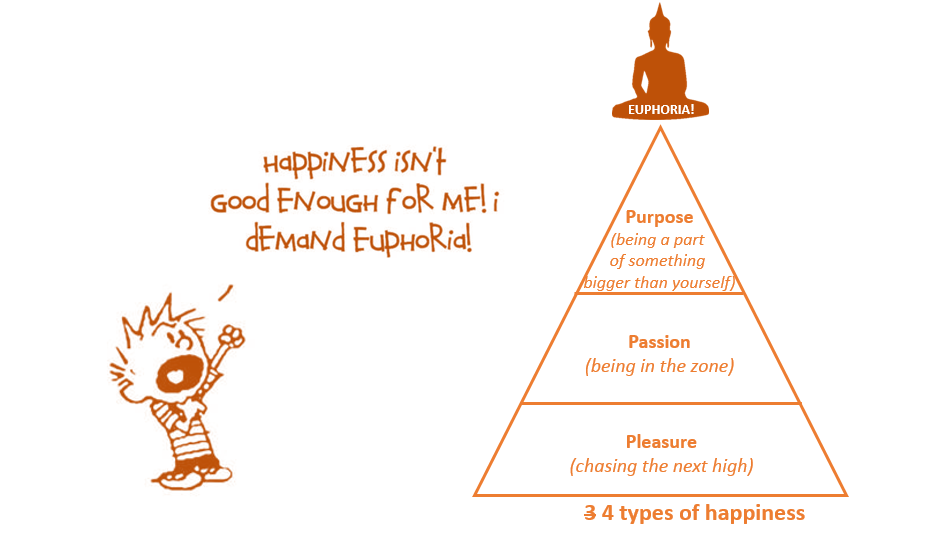
It doesn’t end here for me though. Like Calvin says, “Happiness isn’t enough for me, I demand euphoria.”  

Happiness isn't enough for me, enlightenment

Enlightenment the answer to euphoria?

The more I explore, the more it points me in the direction of spiritual enlightenment. Which in simple Pali means finding out ‘Who am I?” and ‘What am I here for?’ So my search for the meaning of ‘meaning of life’ continues. I also suspect this is the mother of all ‘Meaning of Life’. If we can find the answer to this then…

Love: Is it in the heart or the head?

Mid Week Geek Peek #3

Bird Love

We are not in it alone. Even birds sometimes don’t want to see each others face.

Have you ever wondered why you feel attracted to one person while in love with someone else? Questioned if then the love was true love? Or worse, get distraught when the passion wanes and ask if it was love in the first place? In fact why do we love at all?

Well, I have… asked these questions. For a long time I just tried to find the answers through polite conversations with the demons in my head. That never helps, the polite conversations, right? But “when the student is ready, the teacher does appear.” So Helen Fisher appeared, in eBook format.

In her book “Why We Love”, Helen Fisher clinically dissects ‘love’ as we know it (or don’t know it), helping me quieten the demons (at least some of them), in my head…and I suspect in many other heads too.

She starts her conversation by listing the symptoms of love. (Yeah! like we need a doctor to diagnose matters of the heart). But I guess she had to start somewhere. She explains that ‘romantic love’ is a universal feeling produced by specific chemicals and networks in the brain’. For the geeks out there:

  • Dopamine – Elevated levels of dopamine in the brain produce extremely focussed attention as well as unwavering motivation and goal directed behaviours. These are central characteristics of romantic love – they intensely focus on the beloved, almost to the point of excluding all else, focus on positive qualities, ignore negative.
  • Norepinephrine’s High – A chemical derived from dopamine, may also contribute to a lover’s high. Increasing levels of this stimulant generally produce exhilaration, excessive energy, sleeplessness and loss of appetite – some of the basic characteristics of love. This could also explain why the lover can remember the smallest details of the beloved’s actions and cherished moments spent together.
  • Serotonin – Lover’s persistent, involuntary, irresistible ruminations about a sweetheart may be associated with low level of some type of serotonin. (Obsessive thinking)

But what’s the point in getting all geeky (apart from showing off!). The point being that because the passion emanates from these chemicals, primarily dopamine, motivation and goal oriented behaviour are involved.

Which in simple Klingon means… romantic love is a primary motivation system in the brain – in short, fundamental human mating drive. And like drives –

  • Romantic attraction is tenacious; it is very difficult to extinguish. Emotions on the other hand, come and go, you can be happy in the morning and angry in the afternoon.
  • Romantic love is focussed on a specific reward, the beloved, in the same way hunger is focussed on food.
  • Romantic love is a need, a craving. We need food. We need water. We need warmth. And the lover feels he/she needs the beloved.

So we (broadly) know ‘why we love’ But why does it get so complicated?

She simplifies it by breaking up this ‘mating drive’ into 3 categories –

  1. Lust (craving for sexual gratification) – Lust evolved to motivate individuals to seek sexual union with almost any semi-appropriate partner.
  2. Romantic love – Romantic love emerged to drive men and women to focus their mating attention on a preferred individual, thereby preserving invaluable courtship time and energy. Pair bonding also became essential to raise the off springs resulting in monogamy. They stayed together for 4 years to raise child to infancy, then parted to bear off springs with different partners, which is also probably the evolution of divorce.
  3. Attachment (the feeling of calm, security, and union with a long term partner) – Love changes over time. It becomes deeper, calmer. No longer couples talk all day or ‘dance all night’. The mad passion, the ecstasy, the longing, the obsessive thinking, the heightened energy: all dissolve. But if you’re fortunate, this magic transforms itself into new feelings of security, comfort, calm and union with your partner. There’s a Brazilian saying “Love is born in a glance and matures in a smile”

She agrees however that it may not be that ‘simple’ a relationship. The fact that lust, romantic love and attachment can ignite in any combination makes it ‘It’s complicated’ (and fun?). She says

‘Many of us have periods in our lives when these three mating drives do not focus on the same person. It seems to be the destiny of humankind that we are neurologically able to love more than one person at a time. You can feel profound attachment for a long-term spouse, while you feel romantic passion for someone in the office or your social circle, while you feel the sex drive while you read a book, watch a movie or do something else unrelated to either partner. You can even swing from one feeling to another.’

Yup. That spells fun!

But don’t get all excited people. This doesn’t give you the license for polyamory. Even though polyamory seems logically utopian, she argues that it is impractical – “humankind does not share love gracefully. ‘We are jealous people’ Polyamorous couples not surprisingly spend many hours every week sorting out their feelings of possessiveness and jealousy.”

What’s the solution then for happily ever after?

How do you ignite mad romantic passion in another and sustain it? Especially when nature had designed not a 7 year itch but a 4 year itch?

Helen Fisher’s fundamental tip for ‘forever after’ is to do novel things together. Adventurous stuff increases adrenalin – increases dopamine – increases passion. If your relationship needs a prescription or if you’re simply curious, read her book for other possible solutions for ‘everlasting love’ or simply just to understand this cruelly beautiful emotion that seemingly cannot be tamed.

I on the other hand don’t think there is any universal solution. Each individual and each individual couple needs to explore for themselves what works with all honesty, ‘wanting’ to be together but not ‘needing’ to be together. If anything, explore the possibility of a ‘higher state of love without expectations in the spiritual realm of things’

But then what do I know? Why don’t you share what’s worked for you to keep the magic alive in a not so fairy tale world where the beast may not become a prince.

Principles by Ray Dalios

Mid-Week Geek Peek #2

“Above all else, I want you to think for yourself—to decide                                                                         1) what you want,                                                                                                                                           2) what is true and                                                                                                                                          3) what to do about it.

I want you to do that in a clear-headed thoughtful way, so that you get what you want. I wrote this book to help you do that. “

Ray Dalios is an American businessman and founder of the world’s biggest hedge fund, Bridgewater Associates, with $160 billion in assets. But that’s not why I’ve become a big fan of Ray. I’ve become a big fan because of the “different kind of company” he has created.

Unlike other hedge funds that climb the skyscrapers of Wall Street, Bridgewater Associates

Bridgewater Associates

Workplace or Retreat?

headquarters, located in Westport, Connecticut, is described as retreat-like and is surrounded by the trees of a former nature reserve.

Bridgewater is perceived as almost cult like and he attributes its success to its people and culture. A culture that’s built around what Ray Dalio calls ‘radical transparency’ to the point where cynics call the workplace creepy.

Creepy or not (Bridgewater is under constant surveillance – all meetings, all interviews and all interactions are taped), clearly his practice and philosophy is working.

And his philosophy is what he spells out through over 200 principles that Dalio shares with the hope that it will help not only his employees, but anyone interested in achieving success inside or outside the workplace.

But then what is success?

Dalio’s version of success is: “I believe that it is nothing more than getting what you want—and that it is up to you to decide what that is for you. I don’t care whether it’s being a master of the universe, a couch potato, or anything else—I really don’t. What is essential is that you are clear about what you want and that you figure out how to get it.”

This “success is achieved by people who deeply understand reality and know how to use it to get what they want. The converse is also true: idealists who are not well-grounded in reality create problems, not progress.”

He breaks up his book into 3 distinct parts that can be read either independently or as a connected whole.

Part 1 is about the purpose and importance of having principles in general,

Dalio believes that having principles that work is essential for getting what we want out of life. He also believes that to understand each other we have to understand each other’s principles. He begins by examining the following questions –

1) What are principles?                                                                                                                                2) Why are principles important?                                                                                                               3)  Where do principles come from?                                                                                                          4)  Do you have principles that you live by? What are they?                                                                 5) How well do you think they will work and why?

While taking you through his internal journey and philosophy, he urges you to answer these questions by yourself and when considering each principle, please ask yourself, “Is it true?”

Part 2 explains Dalio’s most fundamental life principles that apply to everything he does.

Very early in his life Dalio learned how important and how liberating it was to think for himself. He developed an approach for himself that he believes will work for you to accomplish great things. Dalio’s approach was –

1) I worked for what I wanted, not for what others wanted me to do

2)  I came up with the best independent opinions I could muster to get what I wanted

3) I stress-tested my opinions by having the smartest people I could find challenge them so I could find out where I was wrong.

4) I remained wary about being overconfident, and I figured out how to effectively deal with my not knowing.

5) I wrestled with my realities, reflected on the consequences of my decisions, and learned and improved from this process

This led him to his most fundamental principle: Truth —more precisely, an accurate understanding of reality— is the essential foundation for producing good outcomes.

He further talks about the 5 choices we need to make as we head towards our goal and his 5 step process to getting what you want out of life.

Part 3, explains his management principles as they are being lived out at Bridgewater. There are over 200 of them logically broken down. Some of my favourites, that transcend into life as well, in random order are –

  1. Trust in truth – realize that you have nothing to fear from truth
  2. Don’t worry about looking good – worry about achieving your goals
  3. Be assertive and open minded at the same time
  4. Recognize that conflicts are essential for great relationships because they are the means by which people determine whether their principles are aligned and resolve their differences.
  5. Recognize that people are built very differently
  6. Don’t act before thinking. Take the time to come up with a game plan
  7. Logic, reason, and common sense must trump everything else in decision-making. However, while logic drives our decisions, feelings are very relevant
  8. Avoid the “theoretical should”
  9. Embrace the power of asking: “What don’t I know, and what should I do about it?”
  10. Remember that your goal is to find the best answer, not to give the best one you have

Like most people who’ve made their billions, Dalio didn’t set out chasing the number of zeroes.

“Yes, I started Bridgewater from scratch, and now it’s a uniquely successful company and I am on the Forbes 400 list. But these results were never my goals—they were just residual outcomes—so my getting them can’t be indications of my success. And, quite frankly, I never found them very rewarding. What I wanted was to have an interesting, diverse life filled with lots of learning—and especially meaningful work and meaningful relationships. I feel that I have gotten these in abundance and I am happy. And I feel that I got what I wanted by following the same basic approach I used as a 12-year-old caddie trying to beat the market”

 “Principles by Ray Dalio” is his approach and fundamental principles he learnt along the way, elaborated in this gem of a manifesto (if I can call it so) for not only anyone building a company, but also for everyone looking for answers to live a better and more “successful” life.

Do you have any life principles? What’s your definition of success?